A skirt and scarf fluttering on a rooftop. When you want dynamic fabric in your images, how much does the wind prompt actually matter?
In this article, we test four levels of wind expression from gentle breeze to sudden gust of wind, comparing how skirts, scarves, and hair respond to each.
Experiment Setup
All conditions use the same base prompt, varying only the wind description. Seeds fixed at 1500, 1600, and 1700 for 3 images per condition.
| Condition | Added Prompt | Purpose |
|---|---|---|
| Control | None | Baseline without wind |
| breeze | gentle breeze | Effect of light wind |
| strongwind | strong wind blowing | Effect of strong wind |
| fromleft | strong wind blowing from left side | Directional wind control |
| gust | sudden gust of wind, skirt and scarf blown dramatically | Sudden gust + explicit fabric instruction |
Control (No Wind)
Baseline with no wind-related description.
| seed 1500 | seed 1600 | seed 1700 |
|---|---|---|
 |  |  |
In all 3 images, the skirt hangs naturally with only slight spread at the hem. The scarf rests on the shoulders with no significant movement. Hair is mostly still.
That said, the long flowing skirt description does produce some spread at the hem. It’s not completely static — more of a “flowing fabric texture” effect.
Experiment 1: gentle breeze
| seed 1500 | seed 1600 | seed 1700 |
|---|---|---|
 |  |  |
With gentle breeze added, all 3 images show the scarf’s edges lifting slightly. The skirt hem flows a bit more than the control.
Hair shows subtle movement, but the difference from the control is minimal. Overall, the change is modest — a sense of calm wind rather than dramatic motion.
Experiment 2: strong wind blowing
| seed 1500 | seed 1600 | seed 1700 |
|---|---|---|
 |  |  |
strong wind blowing produces clear changes. In all 3 images, the scarf billows significantly, lifting away from the shoulders. Hair flows sideways, making the wind immediately visible.
The skirt shows some movement — the hem drifts to one side in 2 of 3 images — but the effect is less dramatic than the scarf and hair.
Notably, the sky becomes darker and more overcast in all 3 images compared to the control and breeze conditions. The strong wind description appears to influence weather depiction as well.
Note: Using
strong windalso tends to darken the sky, indicating that wind-intensity wording influences weather depiction as well.
Experiment 3: strong wind blowing from left side
| seed 1500 | seed 1600 | seed 1700 |
|---|---|---|
 |  |  |
With directional specification added, all 3 images show hair and scarf flowing to the right (from the subject’s perspective). Wind direction is consistent across seeds.
In the strongwind condition without from left side, hair and scarf directions varied between seeds. Adding directional control unified the movement. Direction specification works effectively.
Skirt impact is comparable to the strongwind condition — the hem drifts slightly but gravity keeps it largely in place.
Experiment 4: sudden gust of wind
| seed 1500 | seed 1600 | seed 1700 |
|---|---|---|
 | 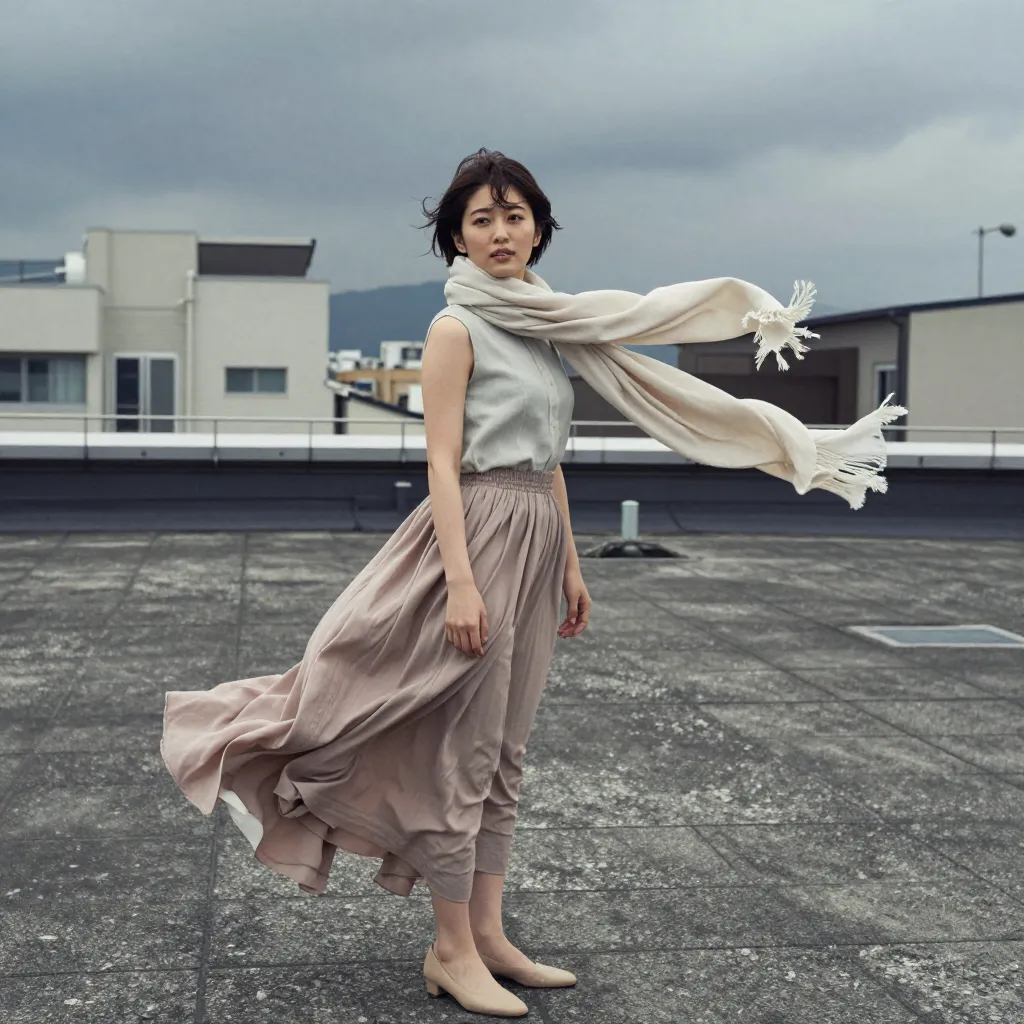 |  |
Adding sudden gust of wind plus skirt and scarf blown dramatically produced the most dramatic results. In all 3 images, the scarf spreads to maximum extension with fringe tips clearly visible in the wind.
The skirt also shows the most movement of any condition — the hem lifts significantly in 3 of 3 images, revealing feet and ankles. The explicit skirt and scarf blown dramatically instruction appears to have made the difference.
Hair is wildly blown sideways. Overall, this is the most dramatic wind expression achieved.
Note: Specifying the target of movement explicitly, as in
blown dramatically, makes a substantial difference. Being explicit about how fabric should move is more effective than describing it vaguely.
Cross-Condition Comparison (Fixed Seeds)
Same seed across all conditions for direct comparison.
| Control | breeze | strongwind | fromleft | gust |
|---|---|---|---|---|
| | | | |
| Control | breeze | strongwind | fromleft | gust |
|---|---|---|---|---|
| | | | |
| Control | breeze | strongwind | fromleft | gust |
|---|---|---|---|---|
| | | | |
Summary
| Element | Control | breeze | strongwind | fromleft | gust |
|---|---|---|---|---|---|
| Scarf movement | Still | Edges lift | Billows significantly | Flows right | Maximum extension |
| Skirt movement | Slight hem spread | Slightly more flow | Drifts to one side | Drifts to one side | Lifts significantly |
| Hair movement | Still | Subtle | Flows sideways | Flows right | Wildly blown |
| Sky darkness | Overcast | Overcast | Dark clouds | Dark clouds | Dark clouds |
Key findings from this experiment:
- Wind intensity scales progressively:
gentle breeze→strong wind→sudden gust of windproduces increasingly dramatic fabric and hair movement - Scarves are most wind-responsive: The lightweight scarf showed visible movement even at the breeze level, while the skirt needed gust-level intensity for major changes
- Directional control works: Adding
from left sideunified the direction of hair and scarf flow across seeds - Explicit fabric instructions matter:
skirt and scarf blown dramaticallyproduced noticeably more skirt lift thanstrong windalone - Wind affects weather depiction:
strong windand above produced darker skies in all images. To maintain a calm sky with strong wind, you may need to explicitly specifyclear skyor similar
Note: Wind-intensity wording spills over into weather depiction as well. To make a skirt lift significantly, explicit instructions like
blown dramaticallyare needed.
![[Verified] Image Generation Prompt Best Practices](/tips/prompt-best-practices/cover_0_0000_4517457392071889496.webp)

![[Experiment] Prompts for Wind-Blown Hair and Clothes | 26 Conditions, 78 Images](/tips/wind-effect-descriptor-test/a11_fluttering_s2_0_0000_4517457392071889496.webp)