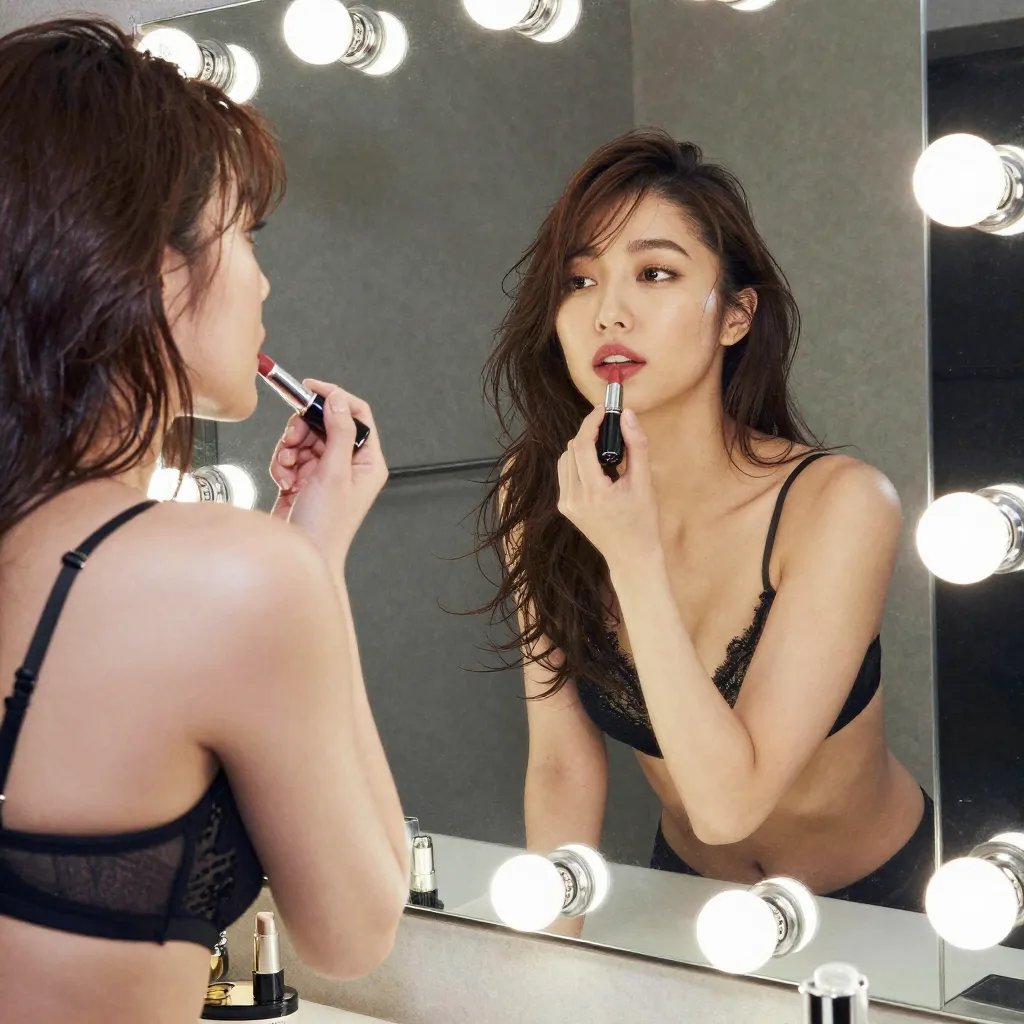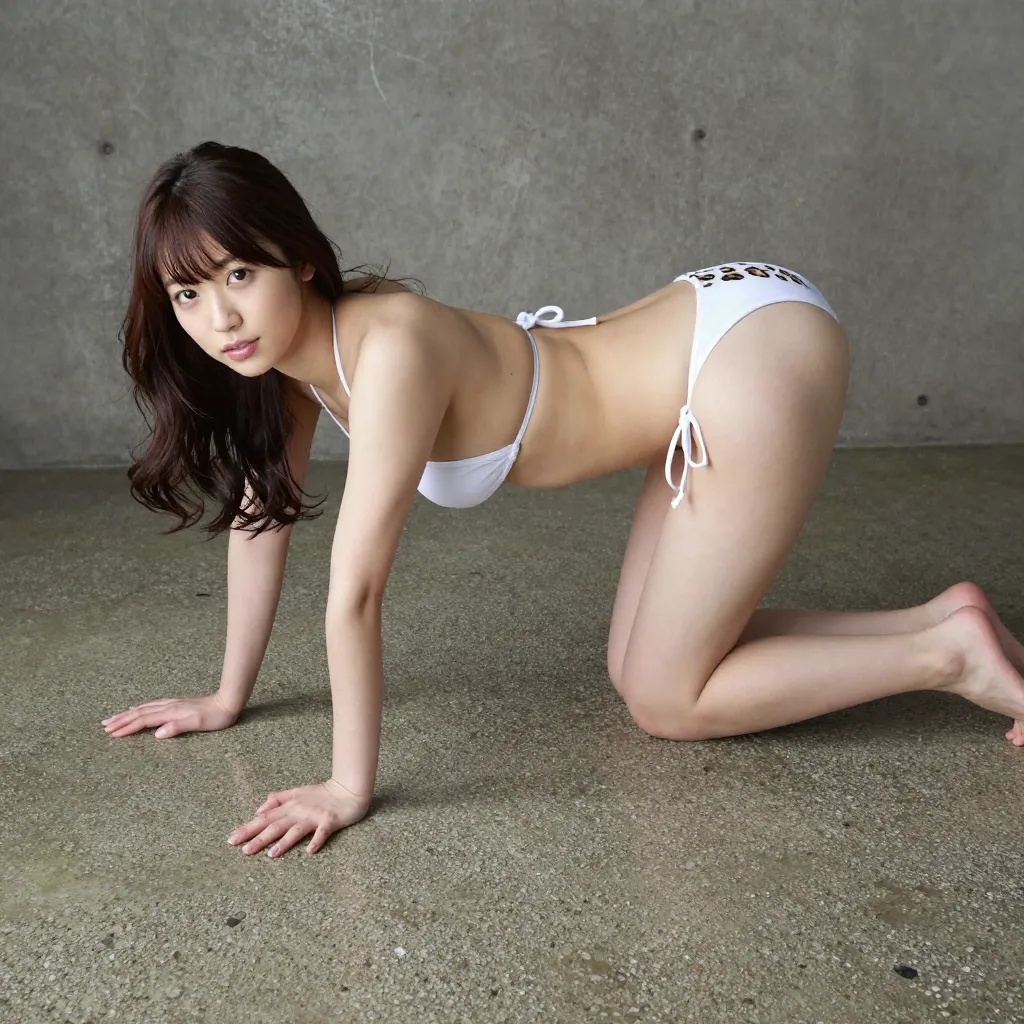
Conclusion
- Mirror selfies are one of the hardest themes in AI image generation — even with the final prompt, success rate stays around 60–70%
full-length mirror+smartphone held at chest heightwas the most effective combination — explicitly stating the mirror while constraining the phone’s position steers the composition toward a convincing mirror selfie- The three main challenges are: physical consistency of the reflection, smartphone + hand/finger depiction, and the duplicate-person problem — the AI model doesn’t “understand” mirror reflection as a physical law
- Generating in bulk and selecting the best images is the practical workflow — there is no “perfect prompt” for this theme, and even a refined 29-word prompt cannot guarantee 100% success
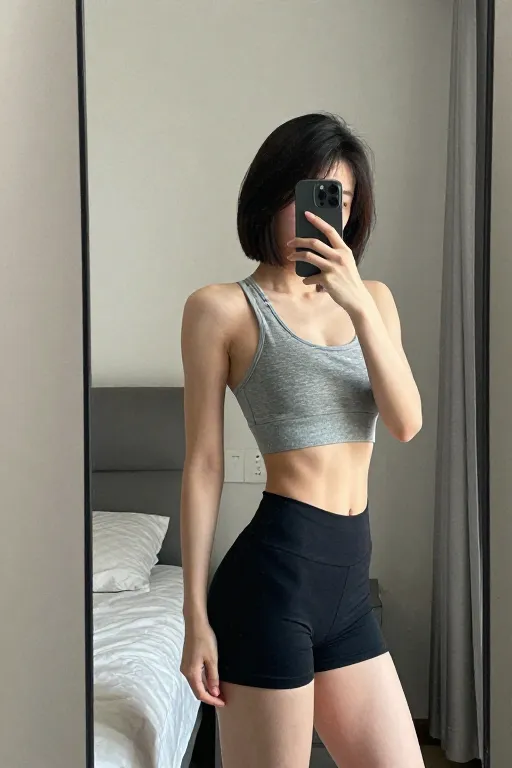
Goal: A woman in a sports bra and shorts takes a selfie in front of a full-length bedroom mirror. Her full body is reflected in the mirror, and her face is visible beside the phone.
Conclusion: Mirror selfies are one of the hardest themes in AI image generation. Even with the final prompt, the success rate is around 60–70%. You’ll need to generate in bulk and select the winners.
Step 0: Start Simple (6 words)
No overthinking — start with the bare minimum.
| Result 1 | Result 2 | Result 3 |
|---|---|---|
 |  |  |
Problems
- A regular photo comes out instead of a mirror shot —
mirror selfiealone often doesn’t produce a mirror-reflected composition - Subject attributes and outfit are entirely random
Step 1: Specify Subject, Outfit, and Location (15 words)
Flesh out the subject’s attributes and location.
- a woman taking a mirror selfie
+ a 22yo japanese woman, mirror selfie, bedroom, gray sports bra, black shorts, smartphone in hand
| Result 1 | Result 2 | Result 3 |
|---|---|---|
 |  |  |
Problems
- The face gets completely hidden by the phone —
smartphone in handalone doesn’t constrain the phone’s position, so it ends up covering the face - The person duplicates — the mirror reflection and real subject are rendered as two different people. The physical reality of mirror reflection is not understood
Step 2: Specify the Mirror and Phone Position More Concretely (25 words)
Explicitly state the type of mirror, the phone height, and how the face should appear.
- a 22yo japanese woman, mirror selfie, bedroom, gray sports bra, black shorts, smartphone in hand
+ a 22yo japanese woman, mirror selfie in bedroom, full-length mirror, gray sports bra, black shorts, medium bob hair, smartphone held at chest height, face partially visible beside phone, natural indoor light
Added elements:
full-length mirror— explicitly states a full-length mirror to force a mirror compositionsmartphone held at chest height— constrains the phone to chest heightface partially visible beside phone— instructs the face to be visible beside the phonemedium bob hair— specifies hairstyle for consistencynatural indoor light— natural indoor lighting
| Result 1 | Result 2 | Result 3 |
|---|---|---|
 |  |  |
Improvements
- The combination of
full-length mirror+smartphone held at chest heightmakes a mirror-selfie-like composition more likely face partially visible beside phonereduces the problem of the face being completely hidden by the phone
Step 3: Add Pose and Snapshot Feel (29 words — Final Version)
Finally, add naturalistic pose and candid snapshot feel.
- a 22yo japanese woman, mirror selfie in bedroom, full-length mirror, gray sports bra, black shorts, medium bob hair, smartphone held at chest height, face partially visible beside phone, natural indoor light
+ a 22yo japanese woman, mirror selfie in bedroom, full-length mirror, gray sports bra, black shorts, medium bob hair, smartphone held at chest height, slightly twisted pose, face visible beside phone, reflected bedroom background, amateur snapshot, no duplicate limbs
Changes made:
slightly twisted pose— a slight body twist for a natural selfie feelface partially visible→face visible— a more assertive instruction to show the facenatural indoor light→reflected bedroom background— explicitly states what’s visible in the mirror backgroundamateur snapshot— captures the feel of a phone selfie rather than a professional shootno duplicate limbs— an attempt to combat the duplicate limb problem (limited effectiveness). Note that in a CFG=1.0 environment, negative words like “no” in the positive prompt may not function as intended
Final Version — 9 Sample Images
Both successful and failed images are shown below — to honestly demonstrate the difficulty of mirror selfies.
 |  |  |
 |  |  |
 |  |  |
Success rate is roughly 60–70%. Around 6–7 out of 9 images turn out as intended, but complete success cannot be guaranteed. Generating in bulk and selecting is the practical approach.
Why Are Mirror Selfies So Hard?
The difficulty of mirror selfies in AI image generation comes down to three technical problems.
1. Physical Consistency of the Mirror Reflection
A mirror image is the left-right flip of the real subject. AI models don’t “understand” this physical law — they reproduce it from patterns in training data. Breakdowns where pose or outfit slightly differs between the real subject and reflection happen frequently.
2. The Double Difficulty of Smartphone + Hand/Fingers
The element AI image generation struggles with most is hand and finger depiction. On top of that, the subject needs to hold a small device like a smartphone, squaring the difficulty. Constraining the position with smartphone held at chest height provides some stability, but it’s not perfect.
3. The Duplicate Person Problem
In a mirror selfie, the same person needs to be rendered twice — as the “real image” and as the “mirror reflection.” However, AI models sometimes render these as two different people. reflected bedroom background hints that the mirror contains a reflection, and no duplicate limbs tries to prevent duplication, but effectiveness is limited.
Word Count Progression
| Step | Words | Main Additions |
|---|---|---|
| 0 | 6 | Minimal prompt |
| 1 | 15 | Subject attributes, outfit, location |
| 2 | 25 | Mirror type, phone position, face visibility |
| 3 | 29 | Pose, snapshot feel, duplicate prevention |
Summary
Mirror selfies are a theme where there is no perfect prompt. Even refined to 29 words, the success rate tops out at 60–70%. That said, it’s a massive improvement over the Step 0 state where regular photos just came out.
The most impactful element was the combination of full-length mirror + smartphone held at chest height. Explicitly stating the mirror while constraining the phone’s position steers the composition toward a mirror selfie.
Related Articles
⚠ 関連記事が見つかりません: /en/tips/nb2-to-zimage
⚠ 関連記事が見つかりません: /en/tips/prompt-refinement
![[Tested] How Far Can You Push the Horror? Escalating Fear with VHS Grain, a Crawling Pose, and Corpse-Pale Skin](/tips/jhorror-escalation-test/g05_maxhorror_s1.webp)