Key Takeaways
sculpted from wet mudbest conveys “clothes made of mud.” Comparing 5 expressions, the shortest formmud dressproduced tattered fabric dresses in 3/3 cases, with weak material recognition. Bothsculpted from wet mudandformed from dripping mudconsistently produced glossy, three-dimensional mud textures in 3/3 cases- Larger garment surface area = better mud material expression. Dresses, coats, and corsets showcase mud sculpting well, but bikinis were interpreted as “muddy fabric bikinis” in 3/3 cases. Too little surface area weakens the mud-as-material reading
- Texture modifiers give you control over the mud’s state.
rough textured mud with cracksproduces dried crackle,glossy smooth mudgives latex-like sheen, andmud mixed with water semi-transparentyields a translucent mud dress — all stable at 3/3 - Watch for background side effects.
thick clay-like mudandrough textured mud with crackstend to spawn massive mud walls in the background. For clean backgrounds,wet dripping mudis the most stable
Experiment Design
| Parameter | Value |
|---|---|
| Model | z-image-turbo (6B, photorealistic distilled) |
| Steps | 8 |
| CFG | 1.0 |
| Size | 1024x1024 |
| Seeds | 3 fixed (42, 43, 44) |
| Framing | full body (some upper body) |
| Total | 17 conditions × 3 seeds = 51 images |
Base Prompt
White background and studio lighting were chosen to maximize visibility of mud textures.
Evaluation Criteria
- Mud material recognition: Can “made of mud” be distinguished from “stained with mud”?
- Garment shape retention: Does the specified outfit silhouette hold?
- Texture fidelity: Do modifier words affect the texture as intended?
- Background side effects: Does the white background remain clean, or does mud texture leak into it?
Experiment 1: Comparing Base Expressions (5 Conditions)
Testing which English phrasing best produces “clothes made of mud” rather than “clothes stained with mud.”
E1-1: mud dress (Shortest Expression)
| seed 42 | seed 43 | seed 44 |
|---|---|---|
 |  |  |
Observations: 3/3 produced “tattered fabric dresses in mud color.” Hems are ragged and torn, with fabric draping still visible. The surface reads more as “fabric dress covered in mud” than “dress made from mud.” Skin and legs also show mud spatters.
E1-2: dress made of mud (Descriptive Expression)
| seed 42 | seed 43 | seed 44 |
|---|---|---|
 |  |  |
Observations: 3/3 recognized it as mud material. Compared to mud dress, the three-dimensionality of the mud increased. Mud dripping from the hem appeared in 3/3 cases. Dress length tends shorter (above-knee to knee-length). More mud on skin as well.
E1-3: dress sculpted from wet mud (Sculpted Expression)
| seed 42 | seed 43 | seed 44 |
|---|---|---|
 |  |  |
Observations: 3/3 produced the strongest “molded mud dress” effect. Glossy wet mud forms a corset-like silhouette that fits closely to the body. The surface shows three-dimensional mud grain and bubble textures. Puddles of mud spread at the feet. No trace of fabric — clearly “a garment shaped from mud as a material.”
E1-4: wet clay dress (Clay Expression)
| seed 42 | seed 43 | seed 44 |
|---|---|---|
 |  |  |
Observations: 3/3 produced dresses with a uniform mud surface. Compared to sculpted from wet mud, the surface is smoother — like thinly spread clay. Less glossy, more matte finish. Silhouette is tank-top style: knee-length (seed 42) or mini (seeds 43/44). Wet hair appeared in 3/3.
E1-5: dress formed from dripping mud (Dripping Expression)
| seed 42 | seed 43 | seed 44 |
|---|---|---|
 |  |  |
Observations: 3/3 produced dynamic dripping effects from the hem. Slightly glossier than sculpted from wet mud, with a viscous quality. Mini-length dresses dominate. Mud grains and clumps dot the surface, with drip trails extending down to the legs and ground. More skin spatters overall.
Experiment 1 Summary
| Expression | Mud Material | Dress Shape | Notes |
|---|---|---|---|
mud dress | △ | ◎ | Tends toward “mud-stained fabric” |
dress made of mud | ○ | ○ | Recognized as mud material, but variable distribution |
dress sculpted from wet mud | ◎ | ◎ | Most stable “molded mud garment” |
wet clay dress | ○ | ◎ | Smooth, uniform texture. Clay-like interpretation |
dress formed from dripping mud | ◎ | ○ | Strong drip/motion expression. High gloss |
Recommendation: Use sculpted from wet mud as the default. Add formed from dripping mud when you want more dynamic movement.
Experiment 2: Outfit Type Variations (7 Conditions)
Using the best expression from Experiment 1 (sculpted from wet mud), we test how different garment shapes interact with mud material.
E2-1: Bikini
| seed 42 | seed 43 | seed 44 |
|---|---|---|
 |  |  |
Observations: 3/3 produced “fabric bikinis covered in mud” rather than “bikinis made of mud.” The string and fabric structure of the bikini remains clearly visible. Too little surface area for mud sculpting — there’s simply not enough garment area for “mud as material” to read. Seed 43 even shows navy-colored fabric intact.
E2-2: Long Coat
| seed 42 | seed 43 | seed 44 |
|---|---|---|
 |  |  |
Observations: 3/3 maintained the coat silhouette with mud material. Decorative three-dimensional mud sculpting (shell-like, vein-like patterns) appeared on the surface — art piece quality. Notable side effect: 3/3 produced a layered composition with a giant close-up of the coat composited in the background. The coat’s large surface area yields the richest mud texture detail.
E2-3: Bodysuit
| seed 42 | seed 43 | seed 44 |
|---|---|---|
 |  |  |
Observations: 3/3 produced tight-fitting mud bodysuits. Mud gloss and adhesion rival the dress results. Seed 42 shows a ghost (semi-transparent double image) on the right side. Mud thickness is thinner than the dress, emphasizing body lines more.
E2-4: Corset + Skirt
| seed 42 | seed 43 | seed 44 |
|---|---|---|
 |  |  |
Observations: The corset portion showed clear mud gloss and lace-up structure in 3/3. The skirt portion tends toward tattered rags (3/3). Background mud spatters or artistic wall surfaces appeared in some cases (seed 42). The corset’s cinched sculpting pairs well with mud material’s three-dimensionality.
E2-5: Boots
| seed 42 | seed 43 | seed 44 |
|---|---|---|
 |  |  |
Observations: The boots themselves look more like mud-colored leather boots than boots made of mud (3/3). The mud influence bleeds into the dress, generating a mud-colored decorative dress. Similar to coats, a layered composition with giant close-ups appeared in the background (2/3).
E2-6: Jewelry + Crown
| seed 42 | seed 43 | seed 44 |
|---|---|---|
 |  |  |
Observations: 3/3 generated earth-toned accessories. Necklaces appear as large mud-colored beads, crowns as floral mud sculptures. The dress also takes on an earth tone, creating a unified palette. Accessories lean more toward “color influence” than “material texture.”
E2-7: Kimono
| seed 42 | seed 43 | seed 44 |
|---|---|---|
 |  |  |
Observations: The kimono silhouette (long sleeves, obi belt, flowing hem) was maintained in 3/3. Mud texture coexists with the kimono’s patterns — a unique combination of mud gloss and traditional motifs. Similar to coats, giant kimono close-ups appeared in the background (2/3). Mud dripping from sleeve tips was also observed.
Experiment 2 Summary
| Outfit Type | Mud Material | Shape Retention | Background Side Effects | Notes |
|---|---|---|---|---|
| Bikini | △ | ◎ | None | Insufficient surface for mud material |
| Long Coat | ◎ | ◎ | High | Decorative mud sculpting. Layered composition |
| Bodysuit | ○ | ○ | Low | Body-hugging with mud gloss. Some ghosting |
| Corset + Skirt | ◎ | ◎ | Medium | Corset structure pairs well with mud |
| Boots | △ | ◎ | High | Closer to mud-colored leather. Layered composition |
| Jewelry + Crown | ○ | ◎ | None | Color influence stronger than material texture |
| Kimono | ○ | ◎ | High | Kimono patterns coexist with mud gloss |
Recommendation: Dress (Experiment 1) and Corset + Skirt offer the best balance of mud material expression and shape retention. Large-area garments (coat, kimono) produce rich mud sculpting but watch for background contamination.
Experiment 3: Texture Control (5 Conditions)
Using dress × sculpted from as the base, we vary the mud’s state with texture modifiers.
E3-1: wet dripping mud
| seed 42 | seed 43 | seed 44 |
|---|---|---|
 |  |  |
Observations: Adding dripping to sculpted from wet mud strengthened the dripping effect from the hem in 3/3. Dress surface gloss increased, with mud grains and bubbles scattered across the surface. Background remained clean white-to-gray.
E3-2: thick clay-like mud
| seed 42 | seed 43 | seed 44 |
|---|---|---|
 |  |  |
Observations: 3/3 showed increased dress thickness with decorative three-dimensional sculpting (spirals, spheres, vein-like patterns) on the surface. High viscosity impression. Background contamination: massive mud walls appeared in 2/3. The walls carry the same sculptural patterns, creating an art installation-like composition.
E3-3: glossy smooth mud
| seed 42 | seed 43 | seed 44 |
|---|---|---|
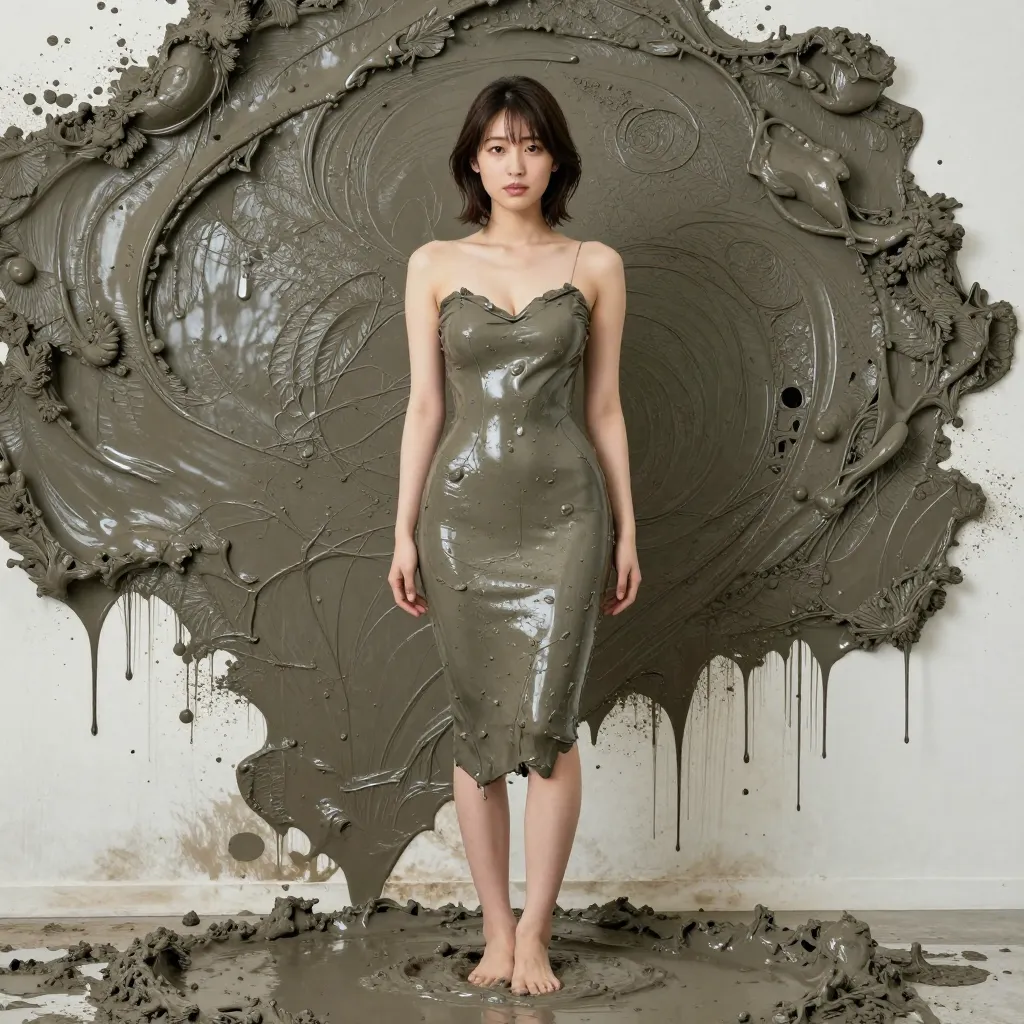 | 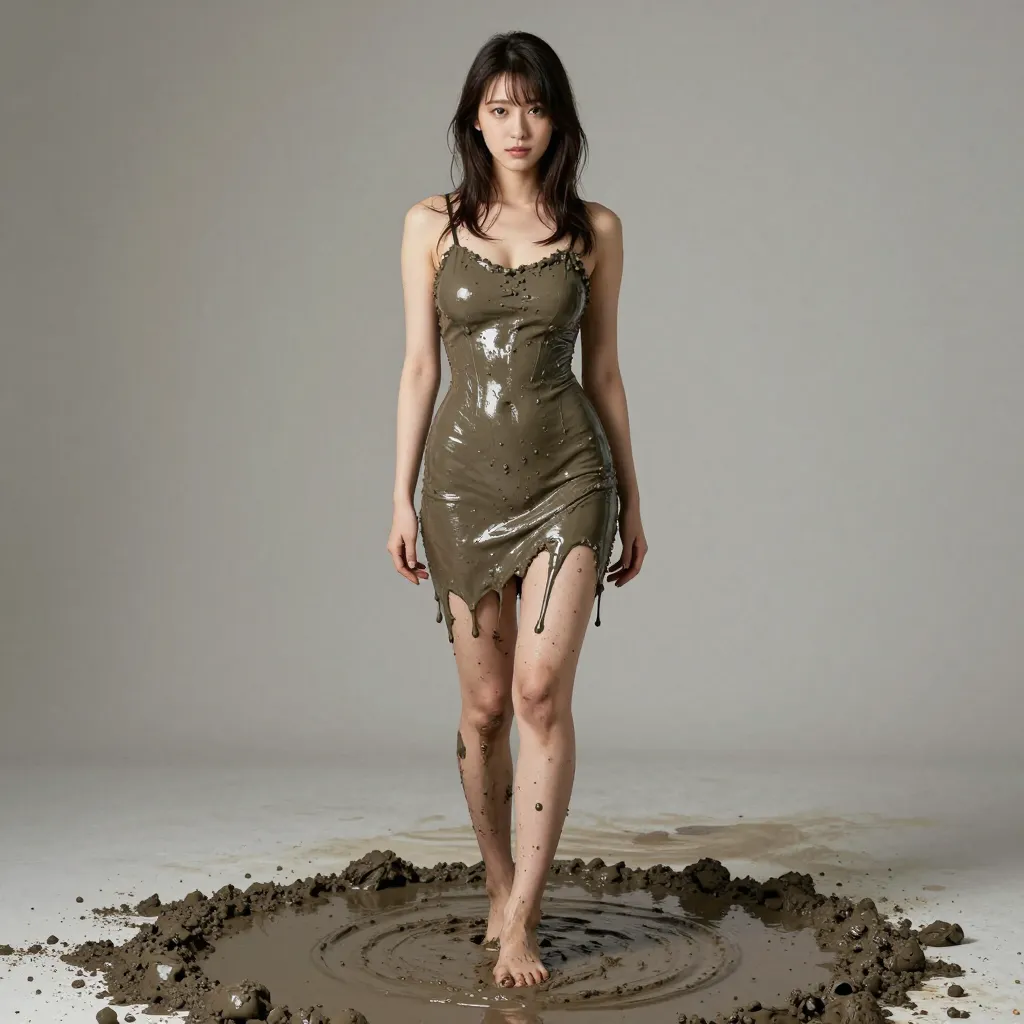 |  |
Observations: 3/3 showed extremely smooth surfaces with strong light reflection. Latex-like gloss. Almost no mud grain — the surface is uniform. Knee-length dresses dominate. Swirling mud art appeared in the background (2/3). Can read more as “glossy earth-tone material” than actual mud.
E3-4: rough textured mud with cracks
| seed 42 | seed 43 | seed 44 |
|---|---|---|
 |  |  |
Observations: 3/3 showed dry, cracked earth textures clearly across the entire dress. The polar opposite of other conditions — zero gloss, fully matte finish. The dress surface becomes a patchwork of dried mud plates. Cracked mud walls also appeared in the background (3/3). Dry mud fragments scattered at the feet. Extremely striking when contrasted with wet mud conditions.
Note: The dried-lakebed-like texture translates directly into the dress design, producing a result that also works as a fantasy costume.
E3-5: mud mixed with water, semi-transparent
| seed 42 | seed 43 | seed 44 |
|---|---|---|
 |  |  |
Observations: 3/3 produced transparent-to-translucent dresses with mud particles suspended inside — a unique result. The texture resembles glass or ice with mud embedded inside, closer to “mud-infused resin” than mud itself. 3/3 show the body visible through the material, a completely different direction from other conditions.
Experiment 3 Summary
| Texture Modifier | Visual Character | Background Side Effects | Mud Authenticity |
|---|---|---|---|
wet dripping mud | Glossy, dripping, dynamic | Low | ◎ |
thick clay-like mud | Thick, decorative sculpting | High | ○ |
glossy smooth mud | Strong gloss, smooth | Medium | △ (latex-like) |
rough textured mud with cracks | Cracked, matte | High | ◎ |
mud mixed with water semi-transparent | Transparent, suspended particles | Low | △ (resin-like) |
Recommendation: For wet mud, wet dripping mud gives the most authentic texture. For dry mud, rough textured mud with cracks produces the most stable results.
Overall Summary
Key findings for prompting “clothes made of mud”:
- The core expression is
sculpted from. This word shifts the interpretation from “stained with mud” to “shaped from mud as a material” - Larger garment area is advantageous. Dresses, coats, and corsets showcase mud sculpting; bikinis and similar small-area items struggle
- Texture is controllable via modifiers. wet/dripping (moist) and rough/cracks (dry) let you clearly control the mud’s state
- Background contamination is a trade-off. Stronger texture modifiers tend to leak mud texture into the background
![[Experiment] Fabric and Material Prompt Test | Comparing 10 Texture Types](/tips/fabric-material-prompt-test/a01_lace_s2_0_0000_4517457392071889496.webp)

![[Verified] Image Generation Prompt Best Practices](/tips/prompt-best-practices/cover_0_0000_4517457392071889496.webp)