Conclusions First
- low angle lowers the camera position to a looking-up composition. The background illumination disappears, replaced by wall and ceiling lighting
- high angle produces an overhead view with ground-embedded lights becoming prominent. The illumination avenue disappears
- dutch angle produces essentially the same frontal composition as control with no screen tilt. No major difference in illumination depiction
- from behind puts the subject with their back to the camera; 2 out of 3 generated an arch-type illumination tunnel structure
- overhead becomes a true overhead bird’s-eye view with the subject lying on grass. Illumination changed to spherical garden lights
- through lights adds bokeh illumination in the foreground, shifting toward a bust-up composition. The full body specification tends to be ignored
- fish eye produces circular barrel distortion across the entire frame, consistently generating a composition of standing in a street lamp-type lighting installation across all 3 images
Experiment Design
| Item | Value |
|---|---|
| Model | z-image-turbo (6B, photorealistic distillation) |
| Steps | 8 |
| Sampler | euler |
| Scheduler | ddim_uniform |
| CFG | 1.0 |
| Size | 1024x1024 |
| Seeds | 3 fixed (common to all conditions) |
| Per condition | 3 images (3 seeds) |
| Total | 8 conditions = 24 images |
Base Prompt
Testing the effect of camera angles in an illumination environment.
A00: control
| seed 1 | seed 2 | seed 3 |
|---|---|---|
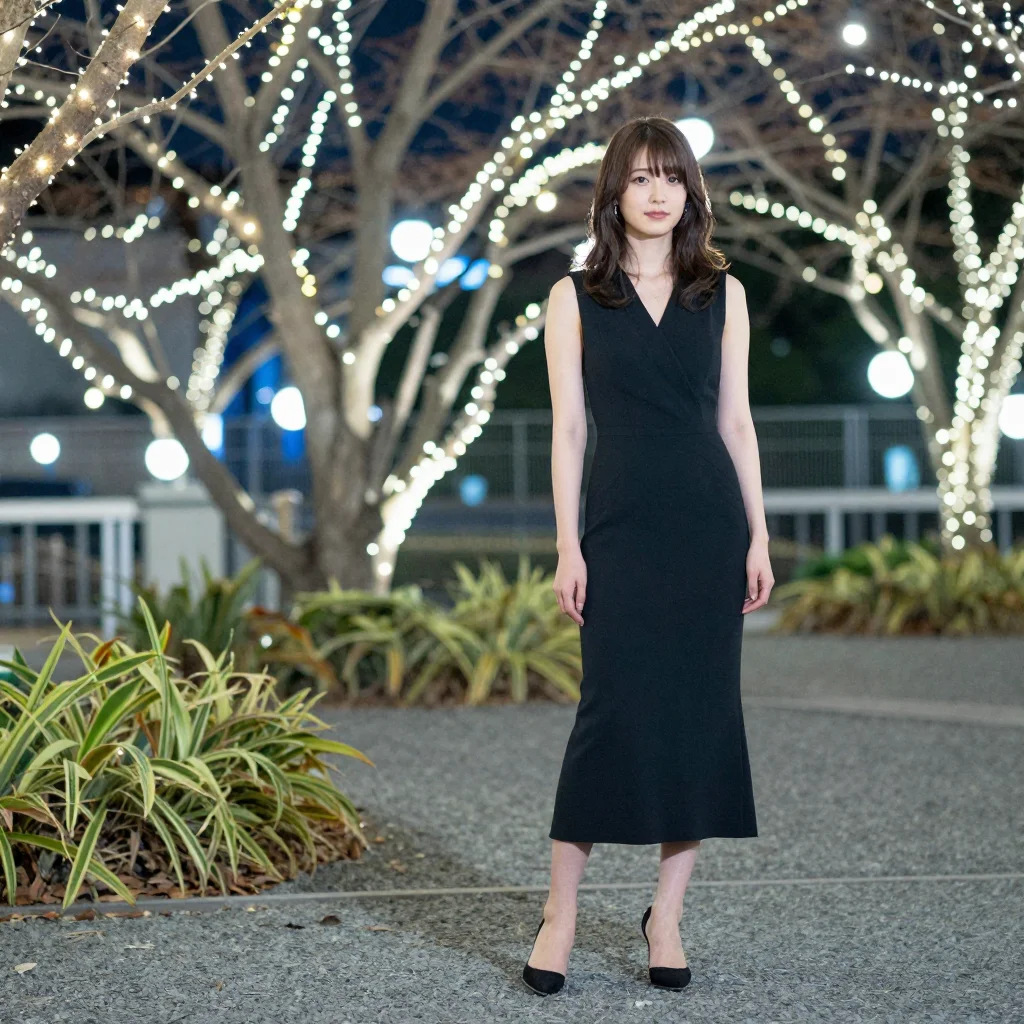 | 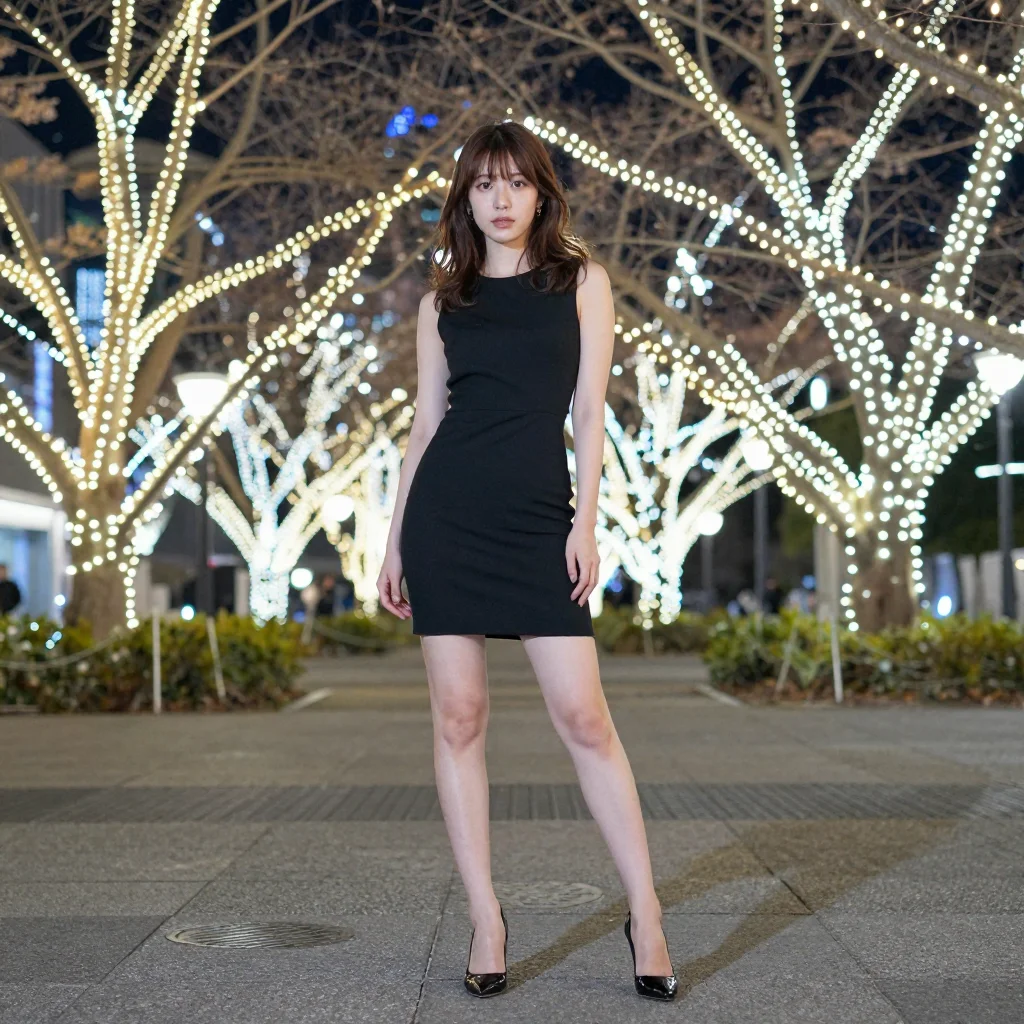 | 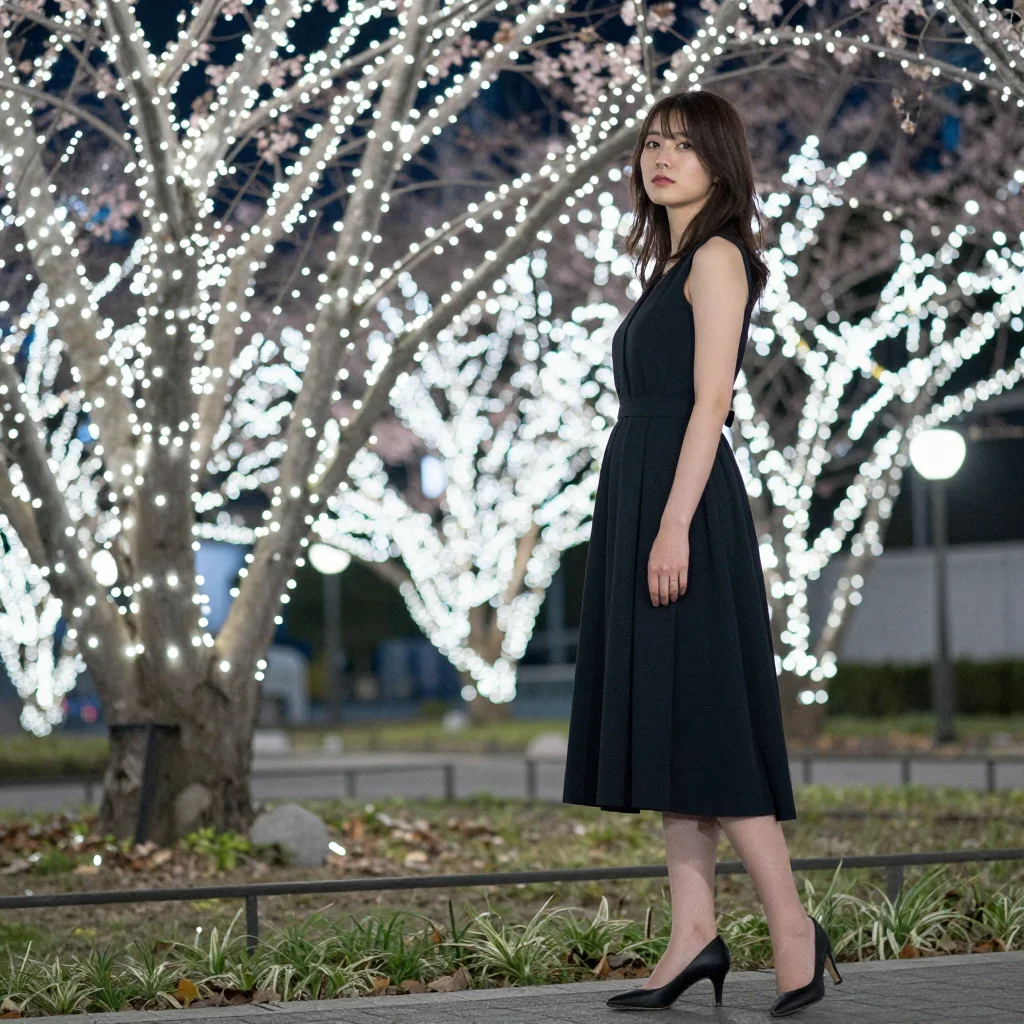 |
Observation: All 3 show a full body composition standing in front of illumination-decorated trees. Camera is at eye level to slightly low, subject centered in frame. Background trees have LED lights wrapped on them, giving a nighttime atmosphere. s1 has some foreground plants, s3 is at a slightly angled composition.
A01: low angle
| seed 1 | seed 2 | seed 3 |
|---|---|---|
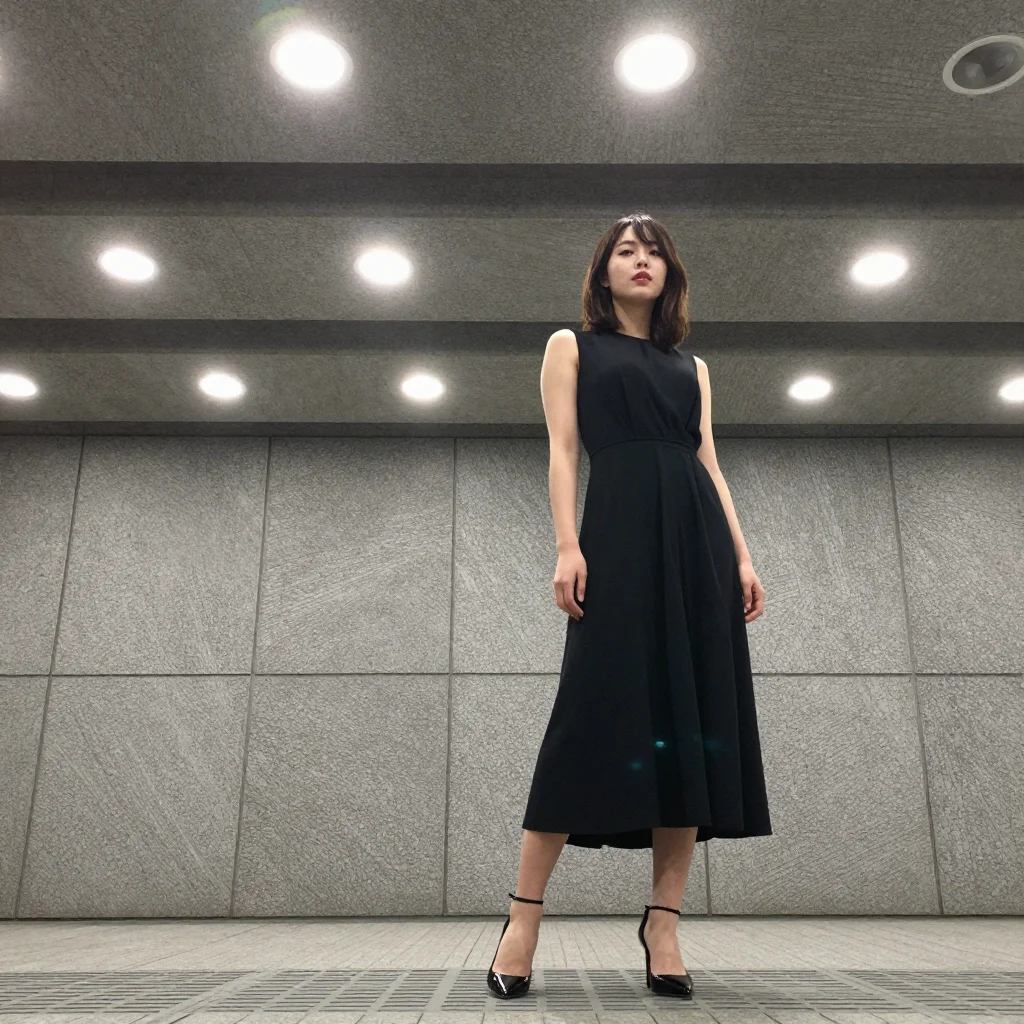 | 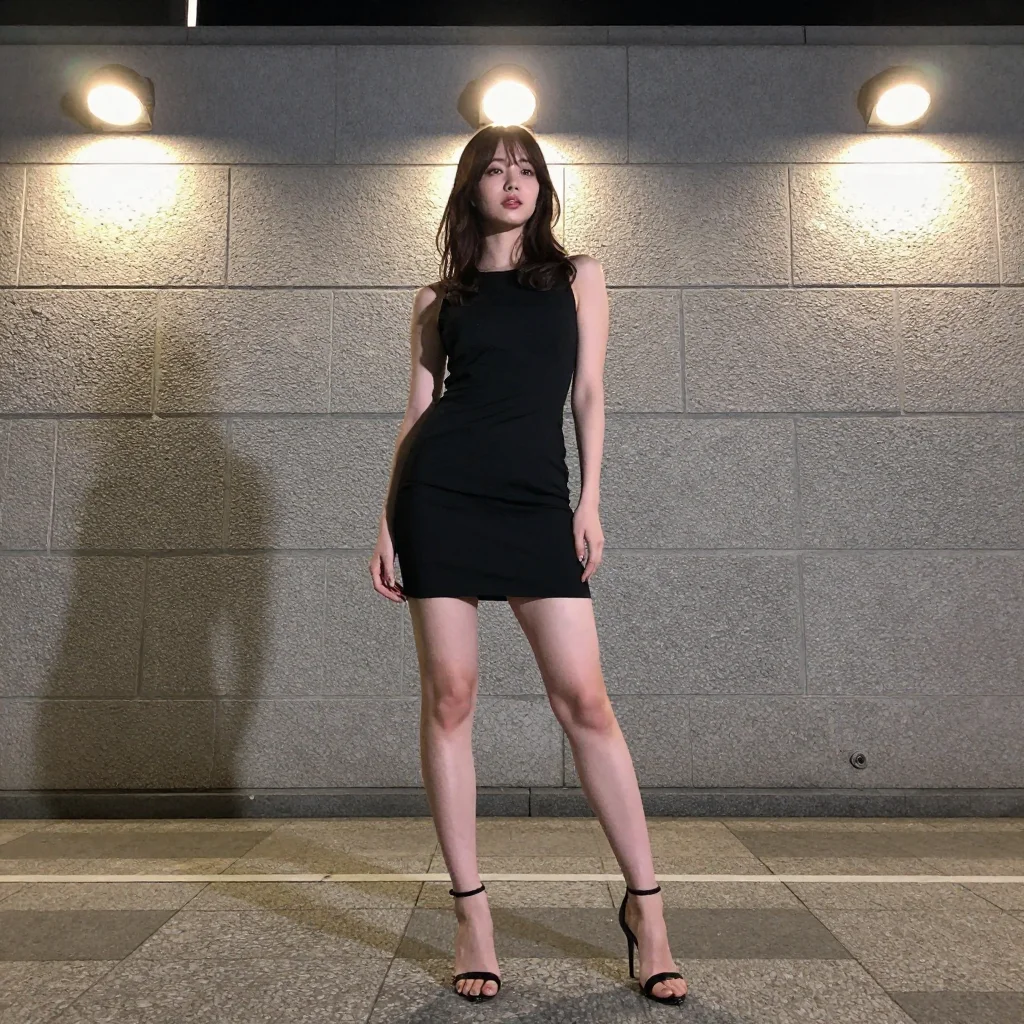 | 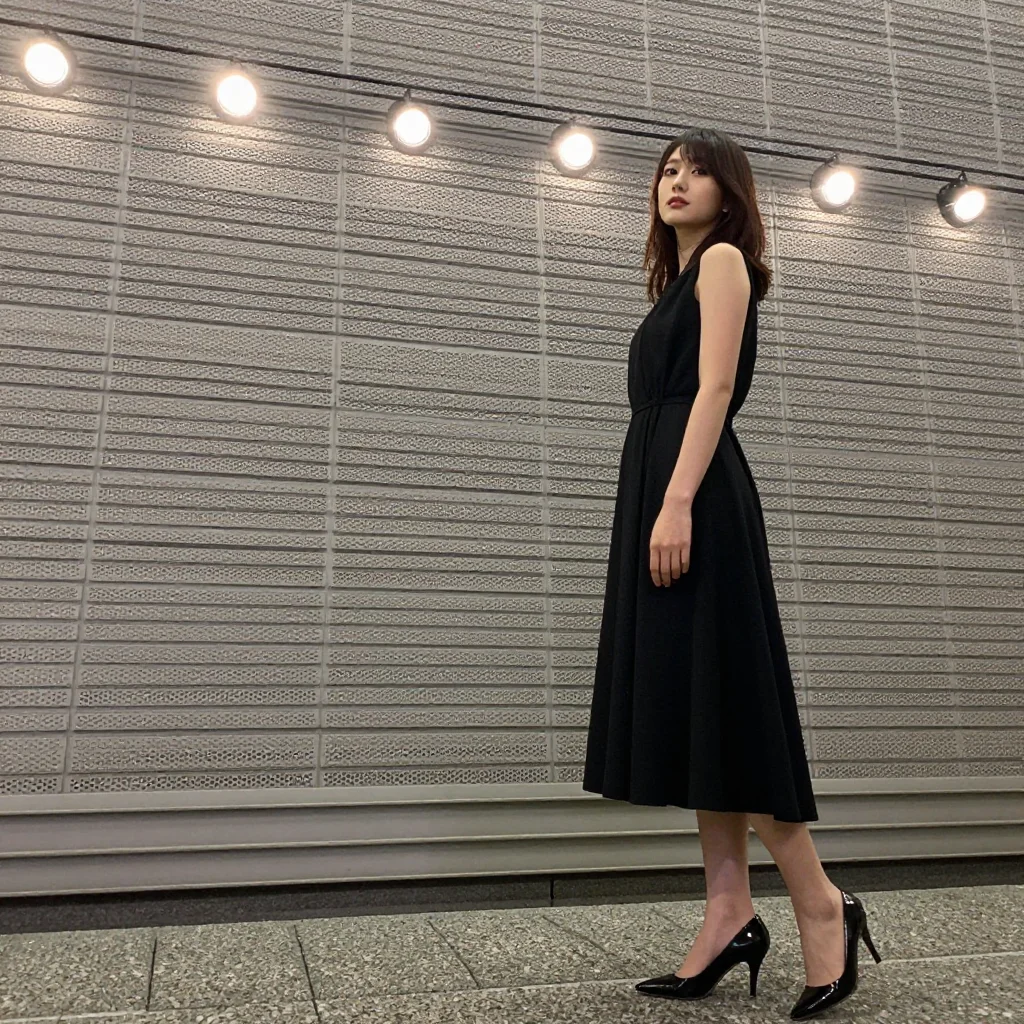 |
Observation: All 3 shift to a composition looking up at the subject from a low camera position. The illumination avenue completely disappears from the background compared to control: s1 becomes a concrete wall with embedded ceiling downlights, s2 has wall lights, s3 has a row of lights on a building exterior. The subject’s feet are closer to the bottom of the frame, creating a leg-lengthening effect. The low angle specification reliably affects composition, but coexistence with the illumination avenue is difficult.
A02: high angle
| seed 1 | seed 2 | seed 3 |
|---|---|---|
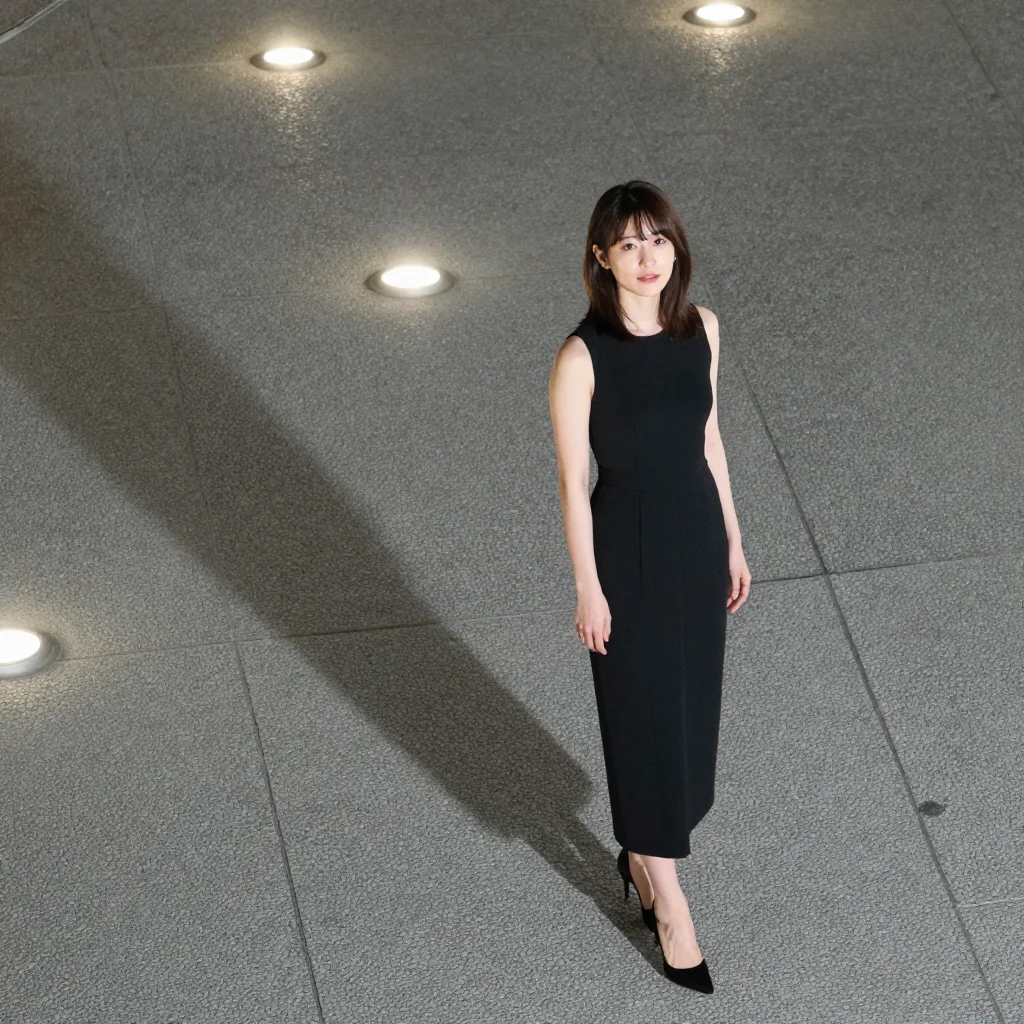 | 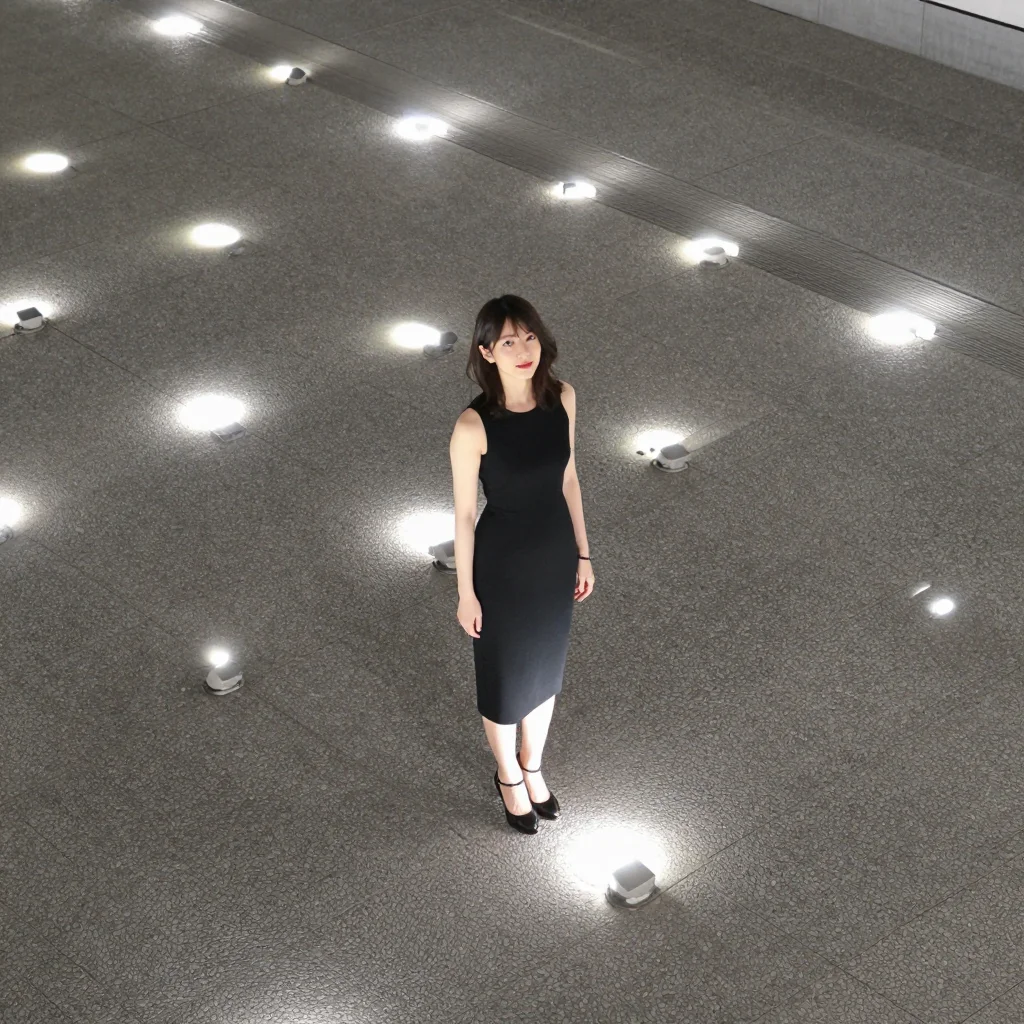 | 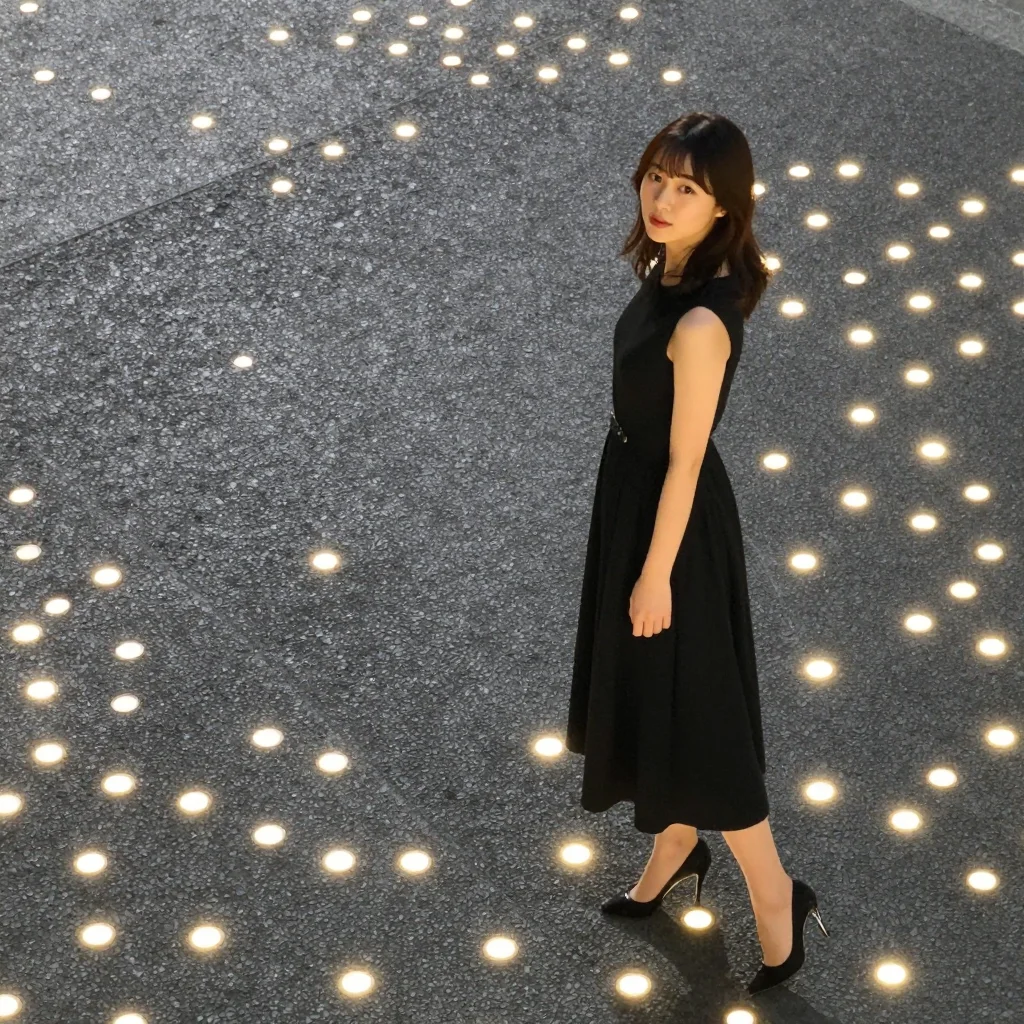 |
Observation: All 3 shift to a composition looking down at the subject from above. The ground takes up more of the background and the illumination avenue completely disappears. s1 is a full body from diagonal above, s2 is a wide area with equally-spaced round ground-embedded lights, s3 also has scattered ground-embedded lights. The top of the subject’s head is visible with shadows on the ground. High angle is as reliable as low angle for composition change, but the illumination avenue is not maintained.
A03: dutch angle
| seed 1 | seed 2 | seed 3 |
|---|---|---|
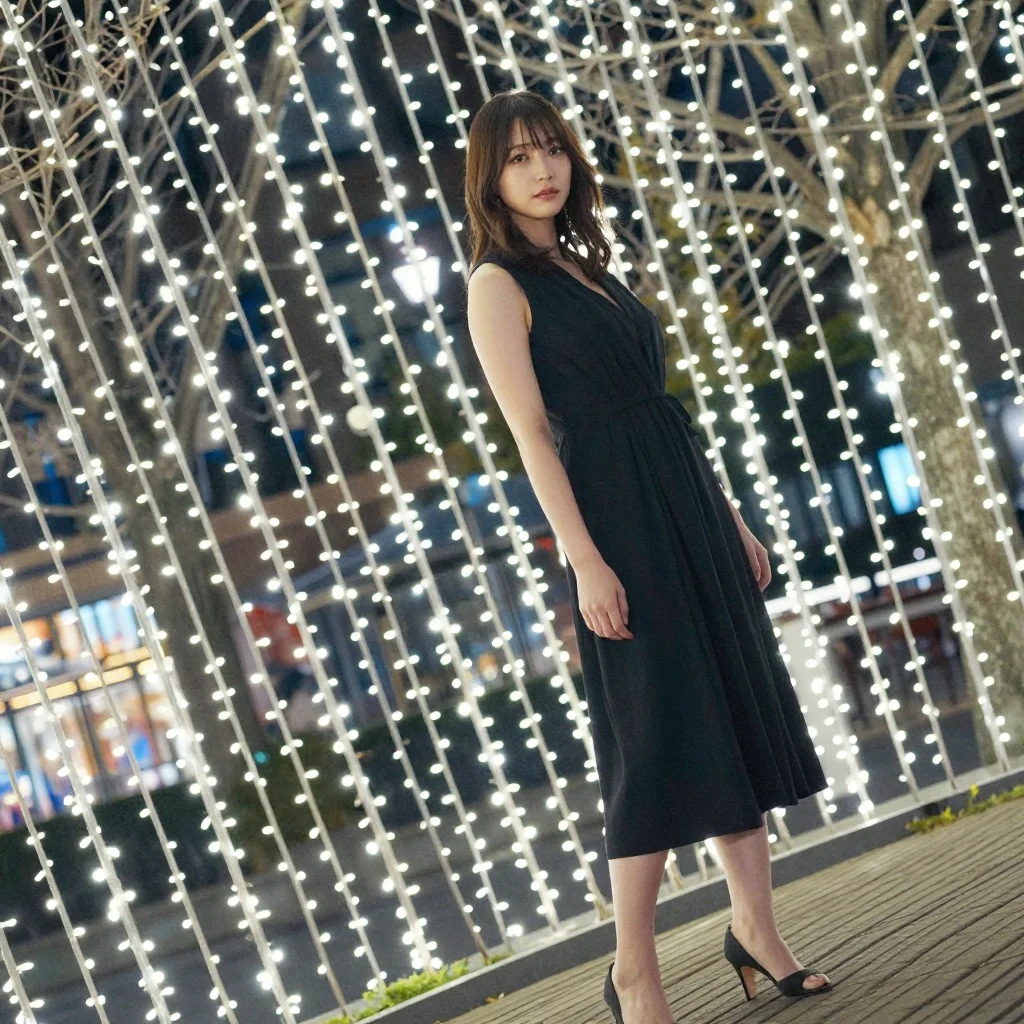 | 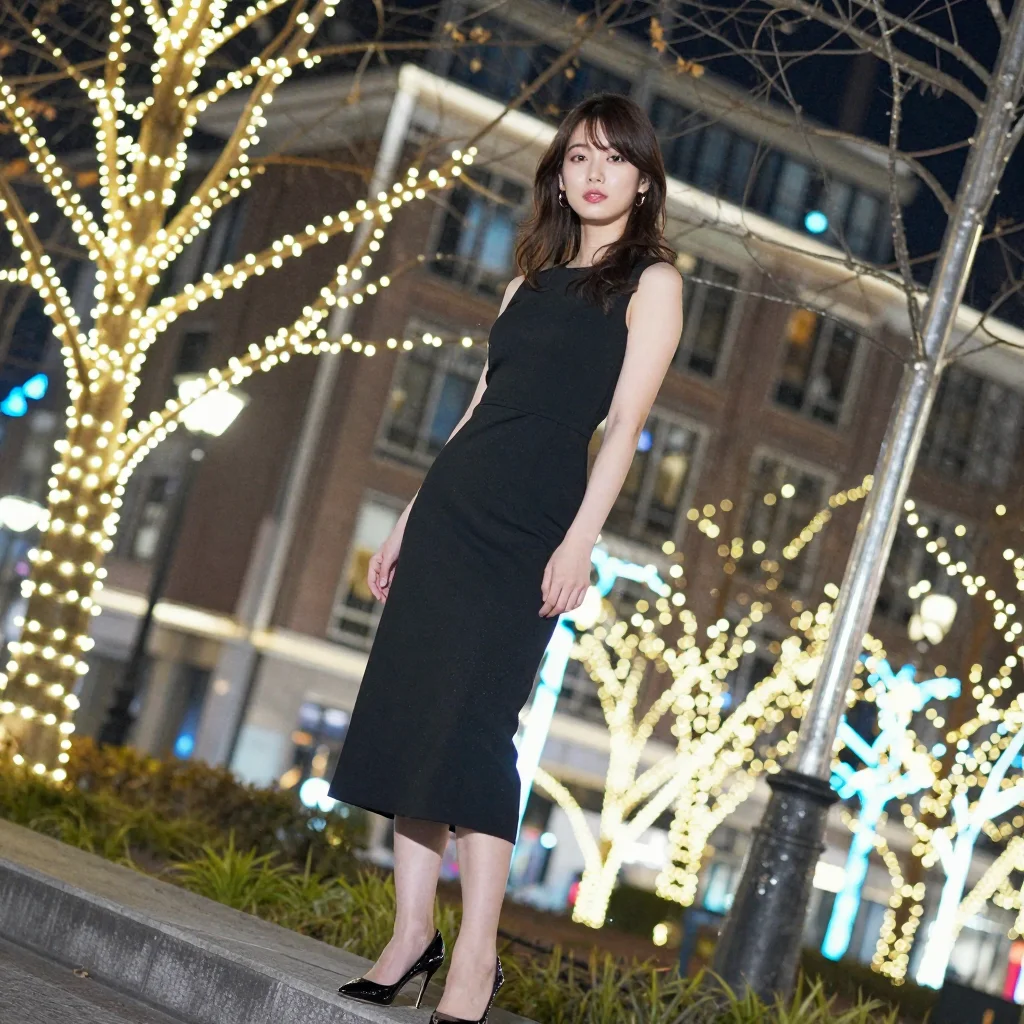 | 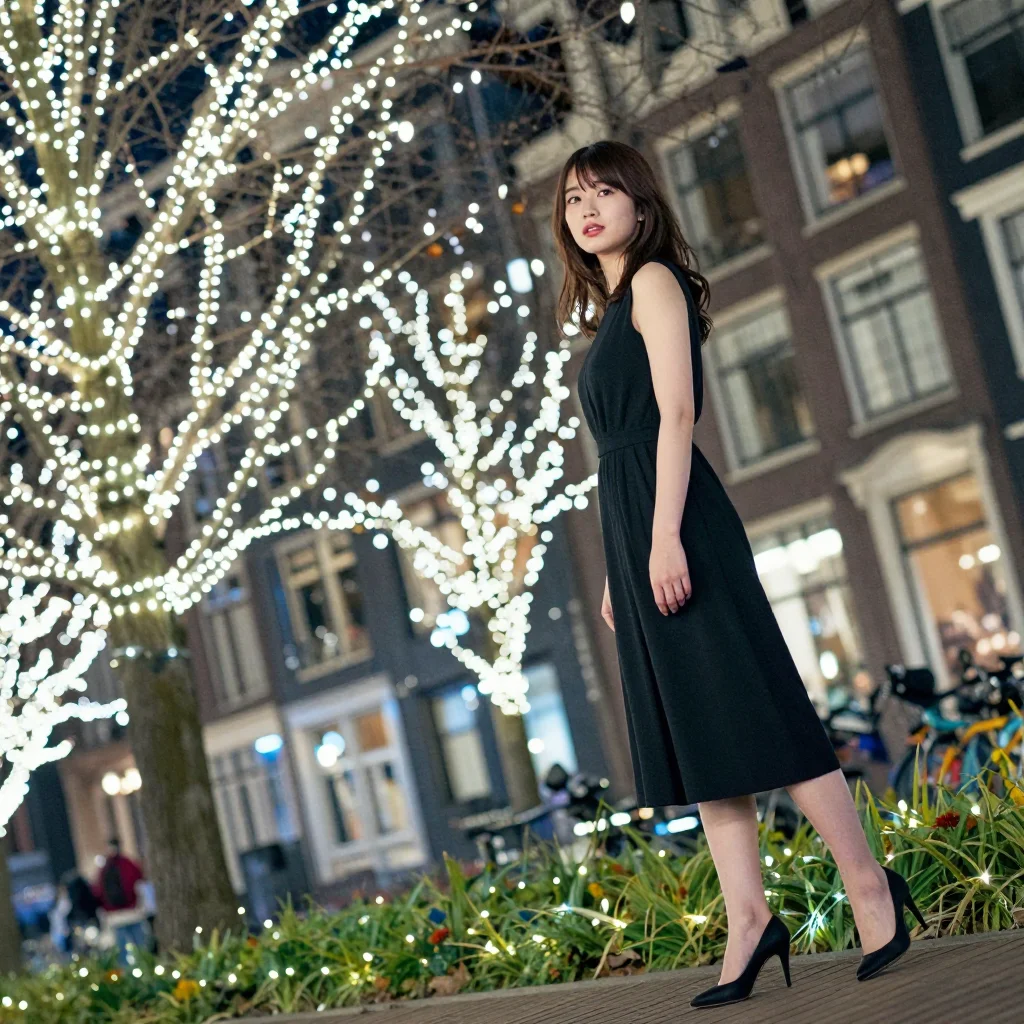 |
Observation: None of the 3 images show screen tilt (the diagonal composition characteristic of dutch angle). The horizontal level is maintained the same as control with a frontal composition. The illumination avenue in the background is also common with control — s1 has a vertically flowing light decoration curtain, s2 and s3 have the tree illumination avenue in the background. The dutch angle specification doesn’t function as screen tilt in z-image-turbo, with no visual difference from control.
A04: from behind
| seed 1 | seed 2 | seed 3 |
|---|---|---|
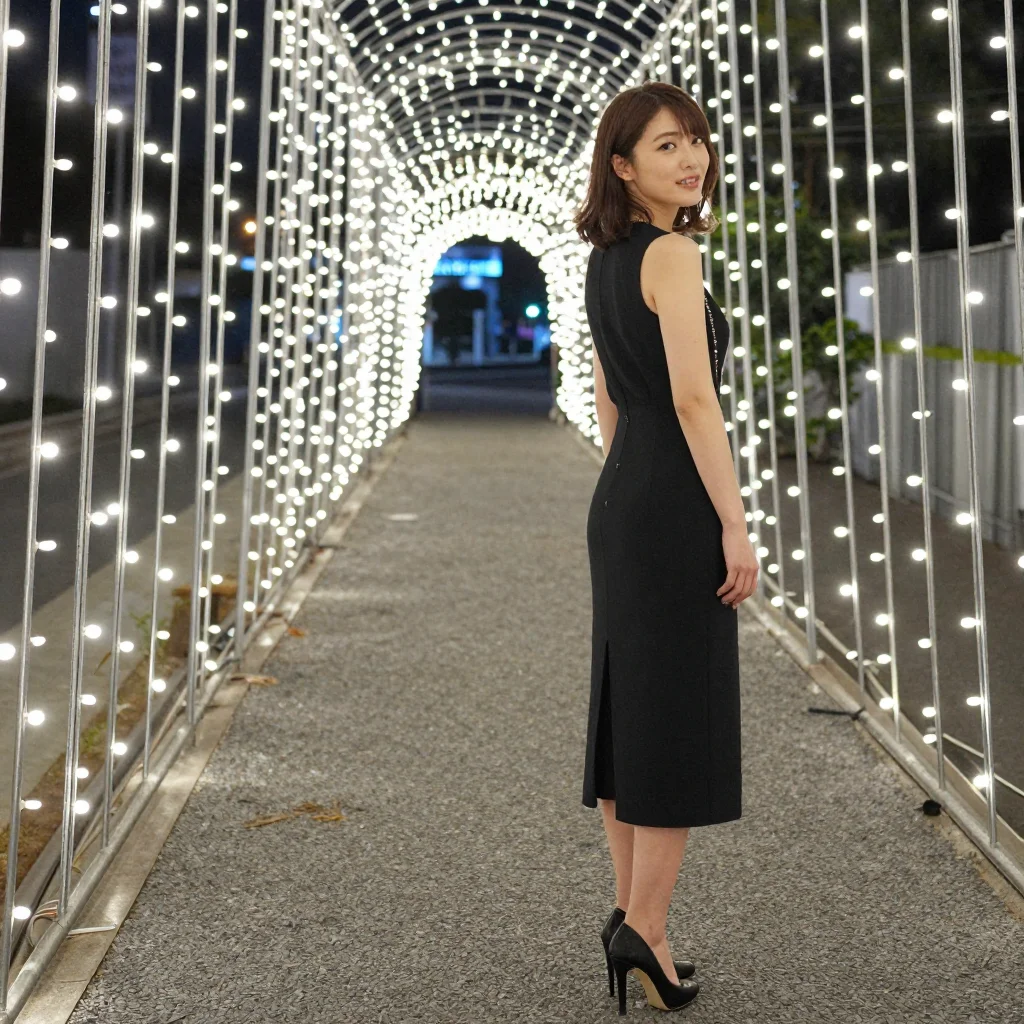 | 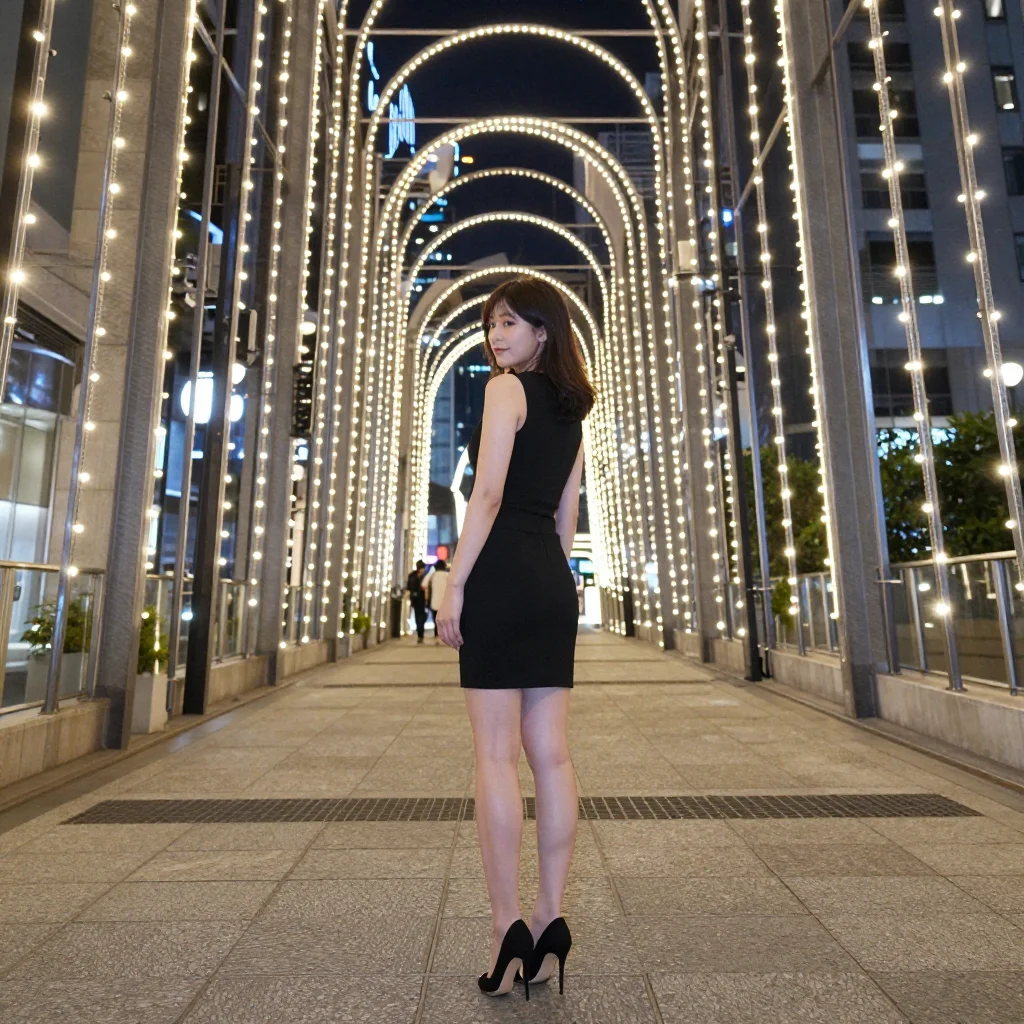 | 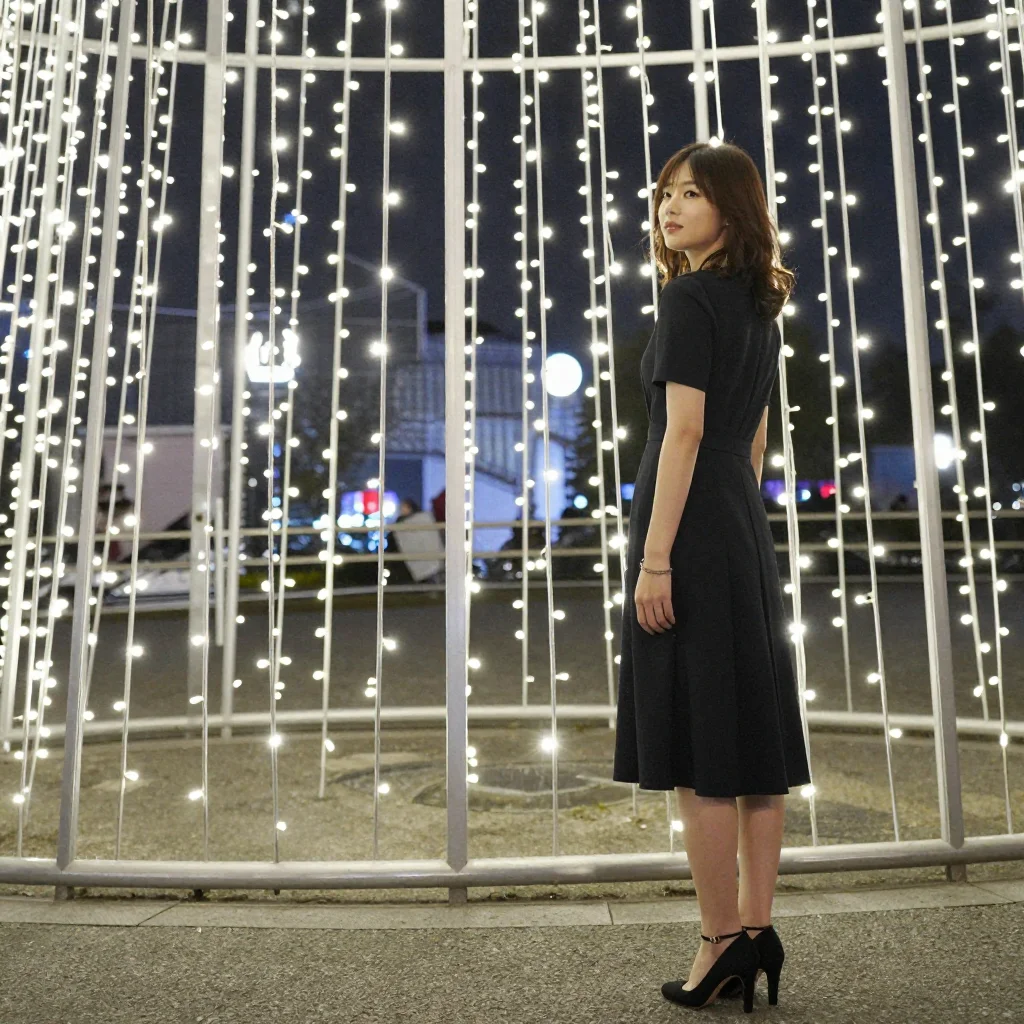 |
Observation: All 3 show a composition with the subject’s back toward the camera — the from behind specification is reliably reflected. s1 shows a composition looking back in the middle of an arch illumination tunnel; s2 also has an arch tunnel with a vanishing point in the distance; s3 stands in a cylindrical structure of vertically hanging illumination curtains. All 3 out of 3 depict illumination as structural constructs (tunnel, curtain), different from the control’s tree avenue. Subjects in all images are posed slightly looking back.
A05: overhead
| seed 1 | seed 2 | seed 3 |
|---|---|---|
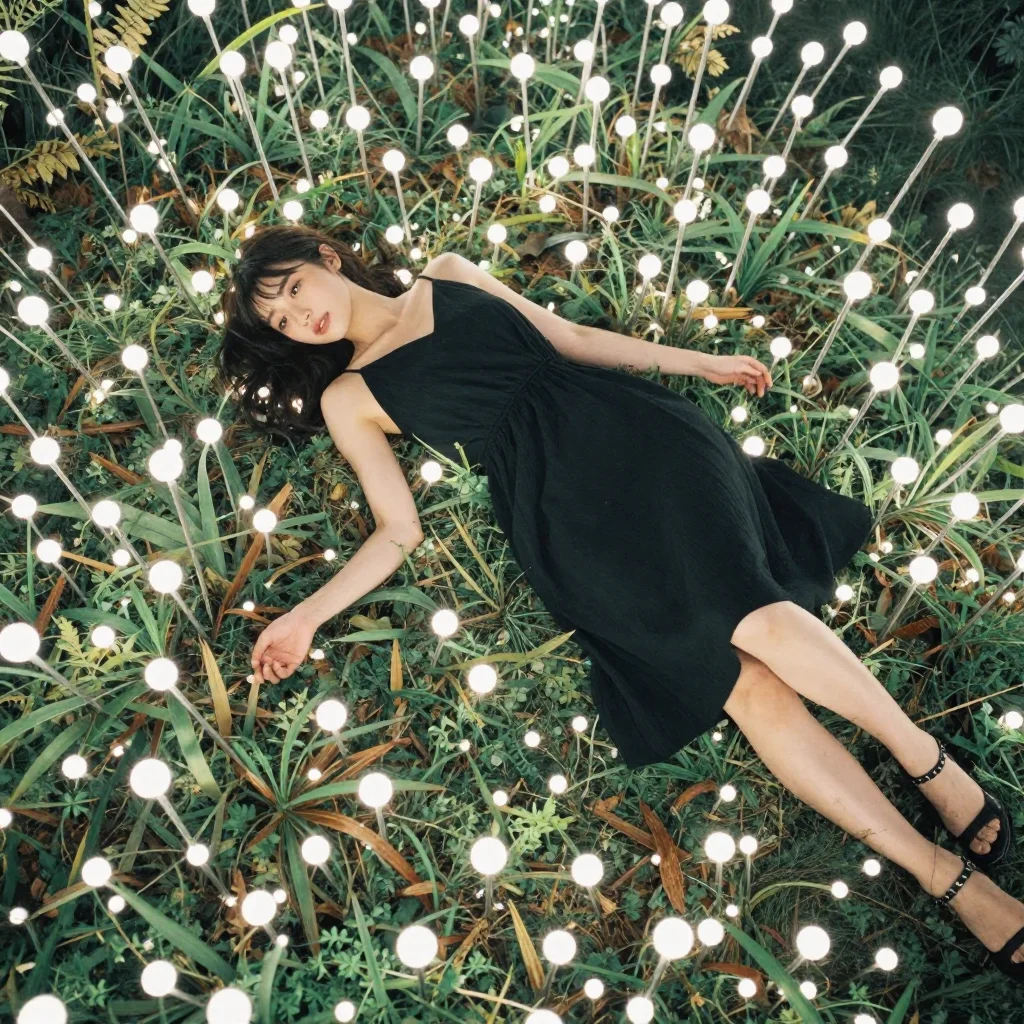 | 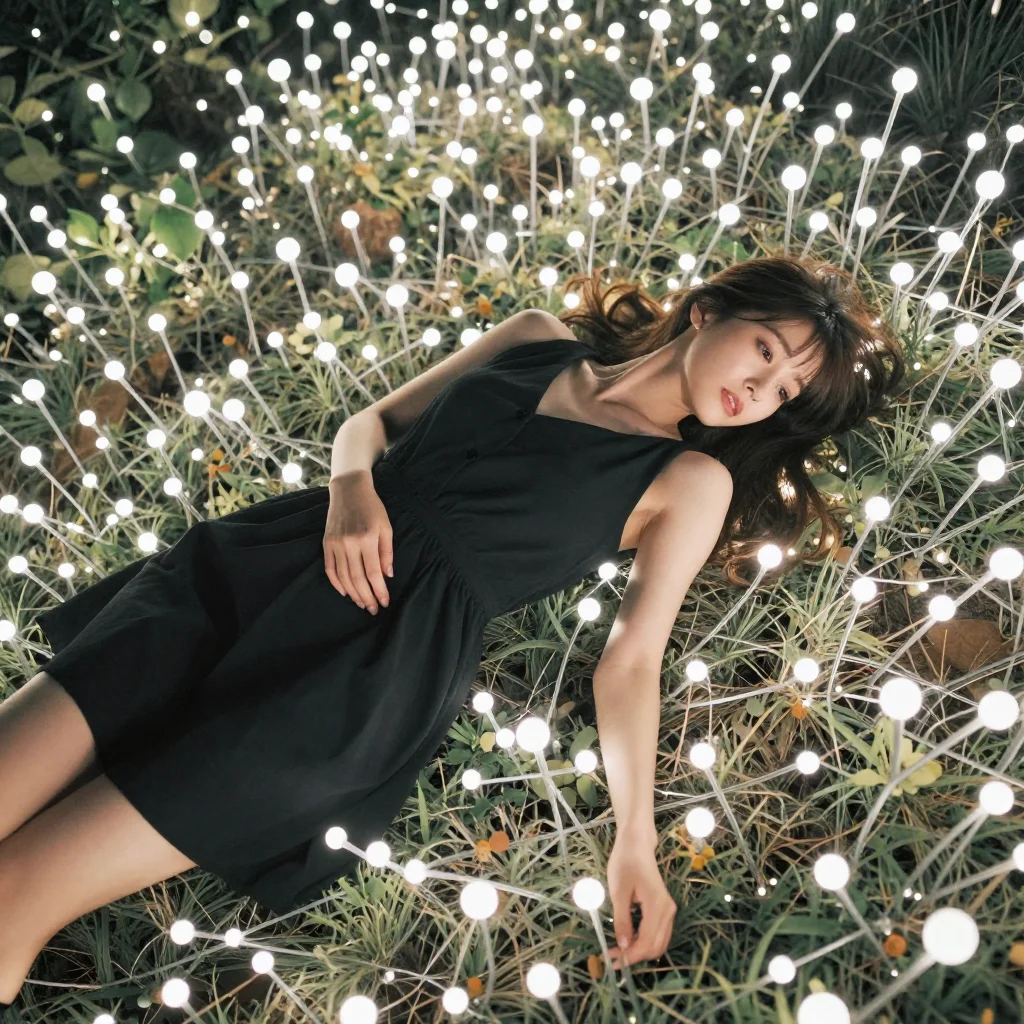 | 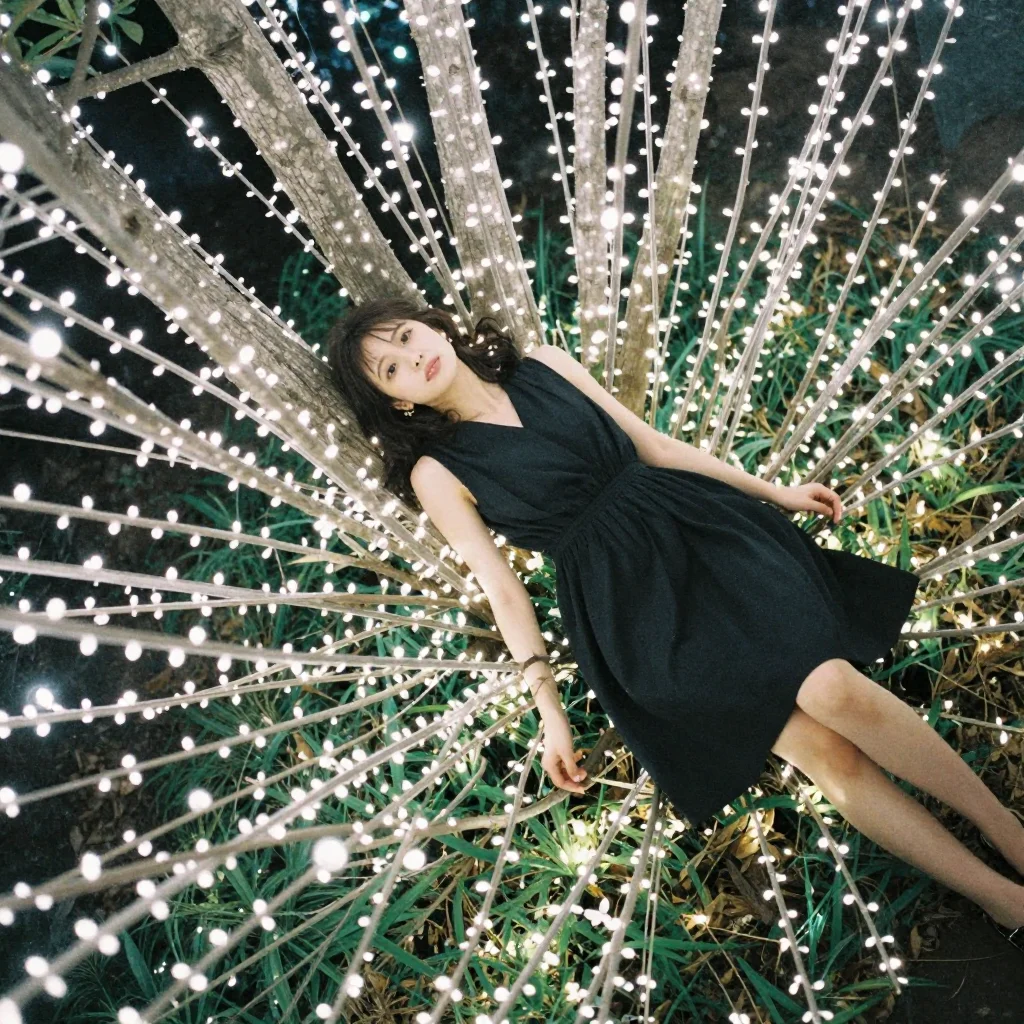 |
Observation: All 3 are shot from nearly directly overhead. The subject is lying face-up on grass with the full body in frame. Illumination is depicted not as an avenue but as spherical garden lights densely clustered around the subject. s3 shows illumination radiating outward from the subject with lights wrapped around tree branches too. The overhead true top-down composition is stably reproduced, but note that “standing full body” becomes “lying-down full body.”
A06: through lights
| seed 1 | seed 2 | seed 3 |
|---|---|---|
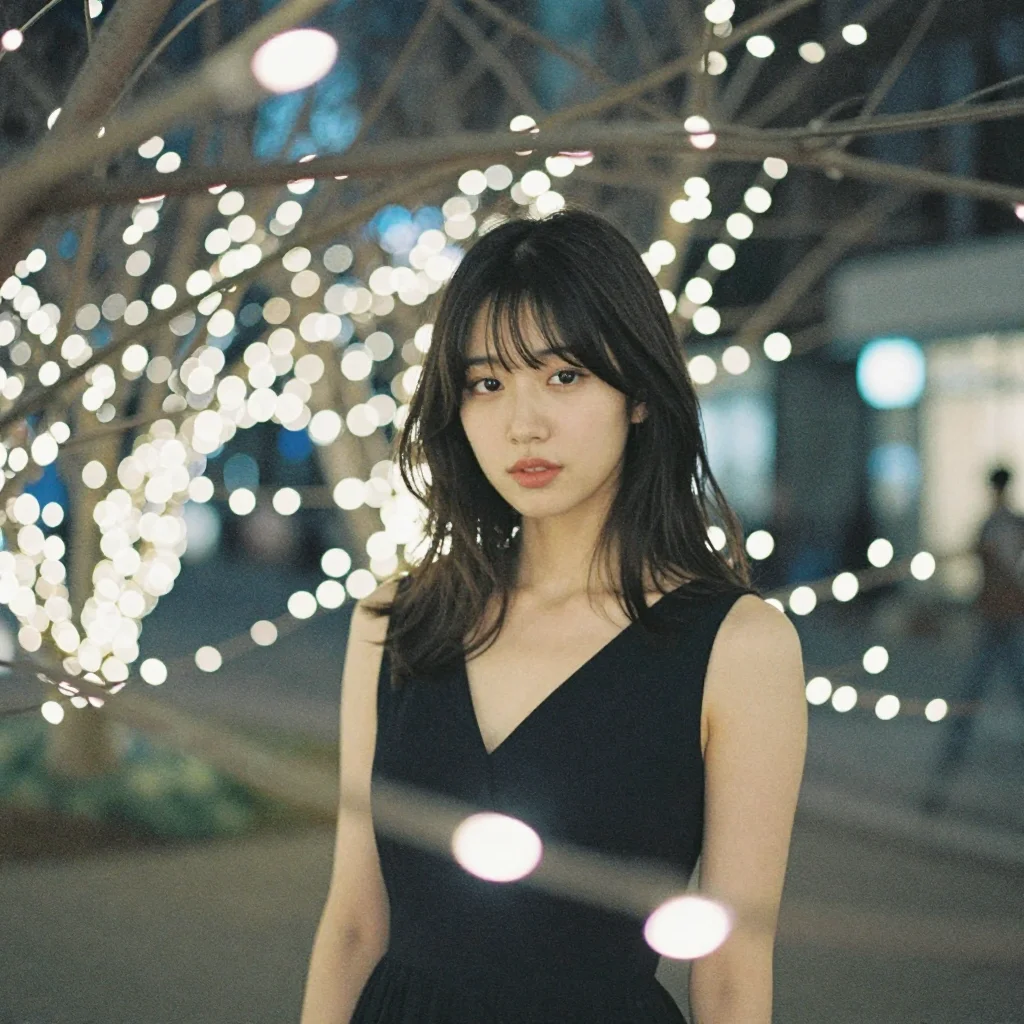 | 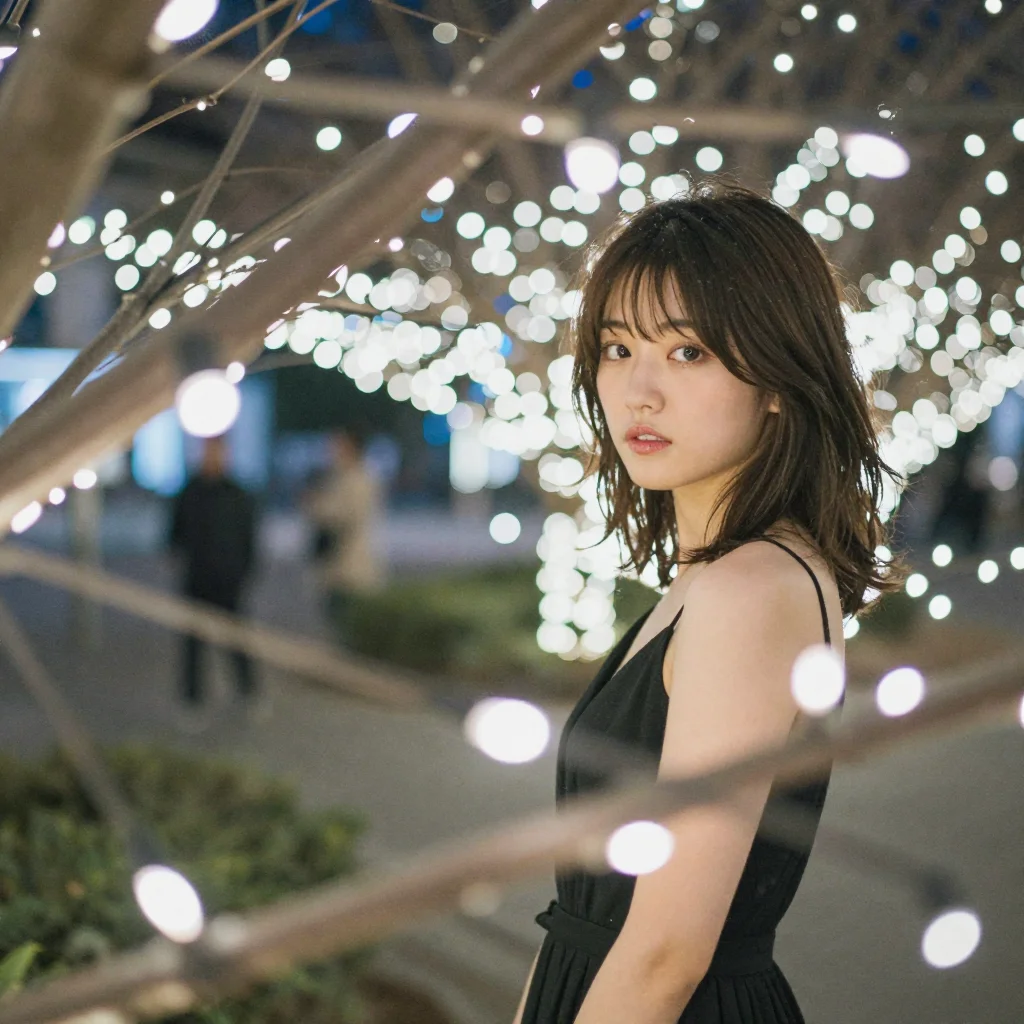 | 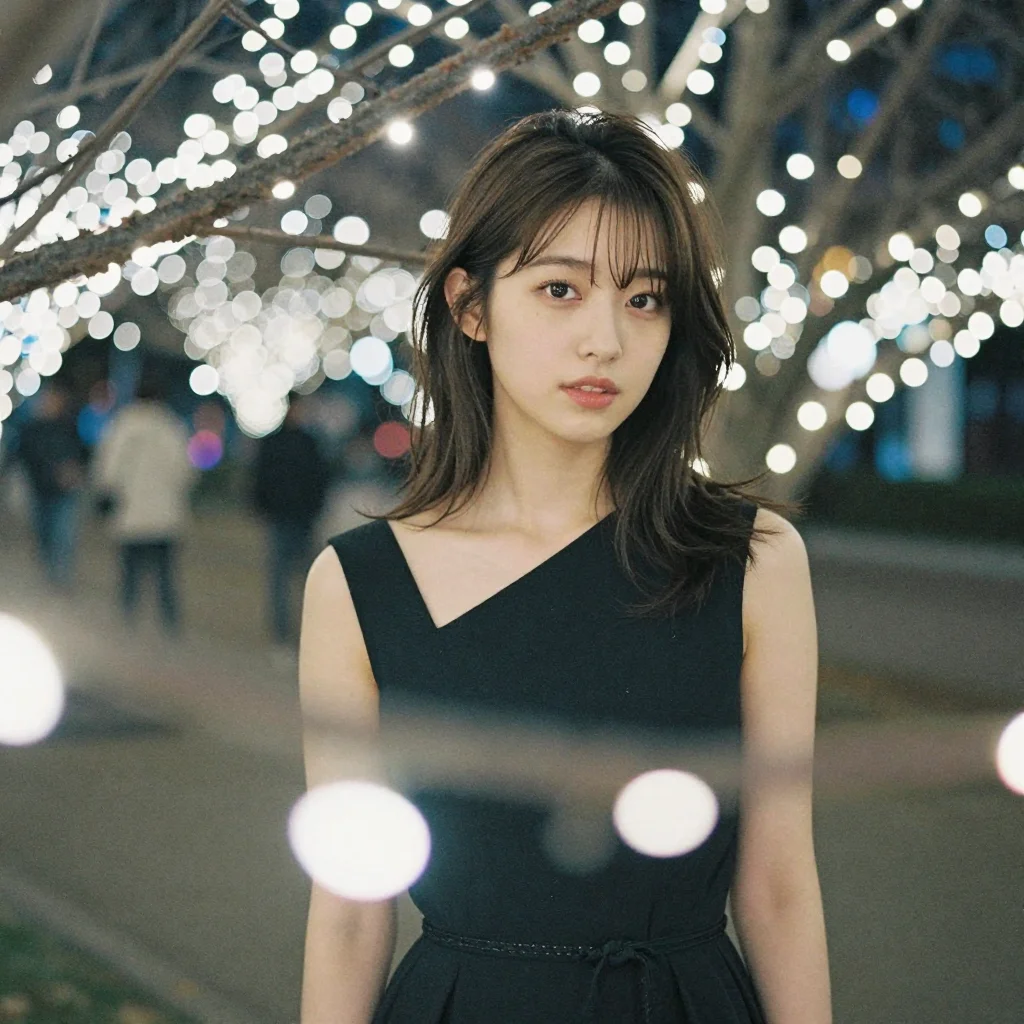 |
Observation: All 3 show illumination bokeh entering as foreground. Branches and light sources between the camera and subject create large round bokeh overlapping in the foreground. s1, s2, and s3 are all bust-up to waist-up compositions — the full body specification is not reflected. The illumination avenue bokeh in the background is also large, with focus on the subject’s face. Through lights stably functions as a foreground bokeh effect, but coexistence with a full body composition is difficult.
A07: fish eye
| seed 1 | seed 2 | seed 3 |
|---|---|---|
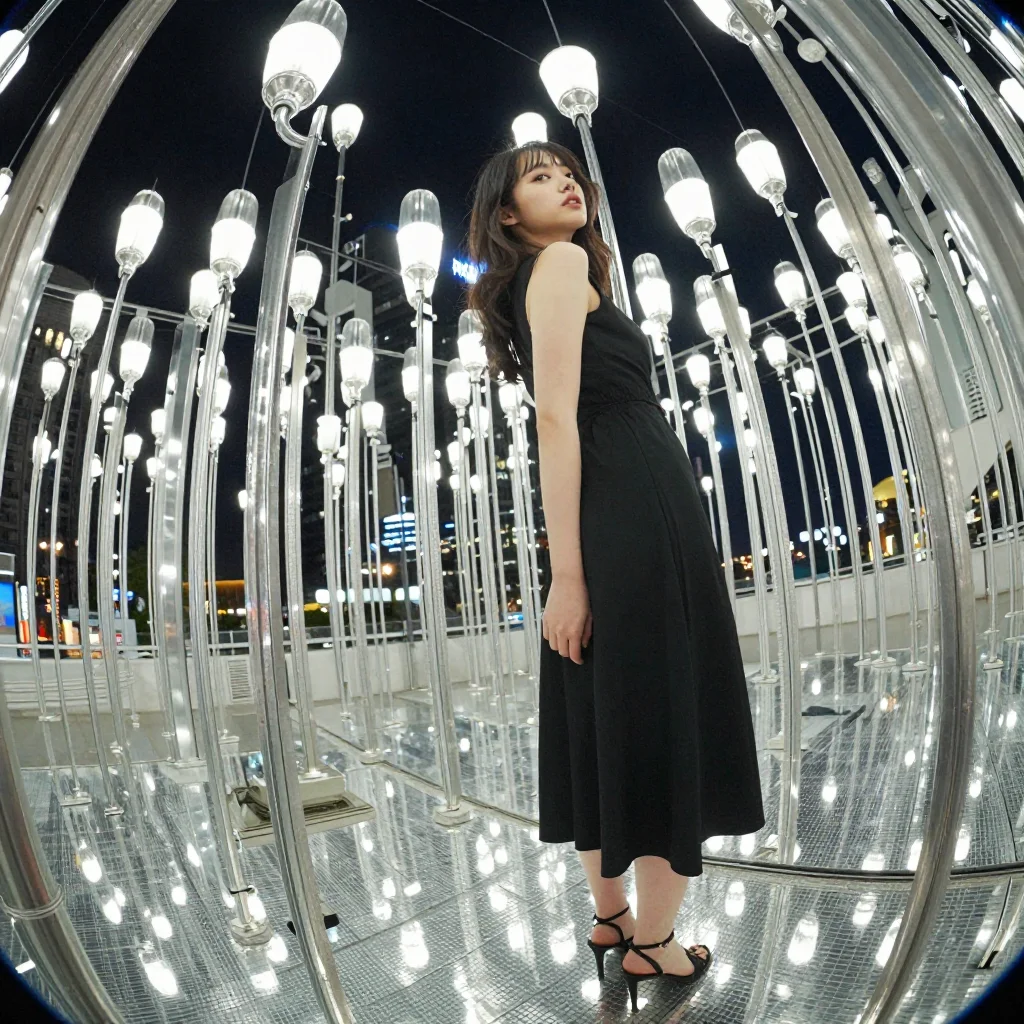 | 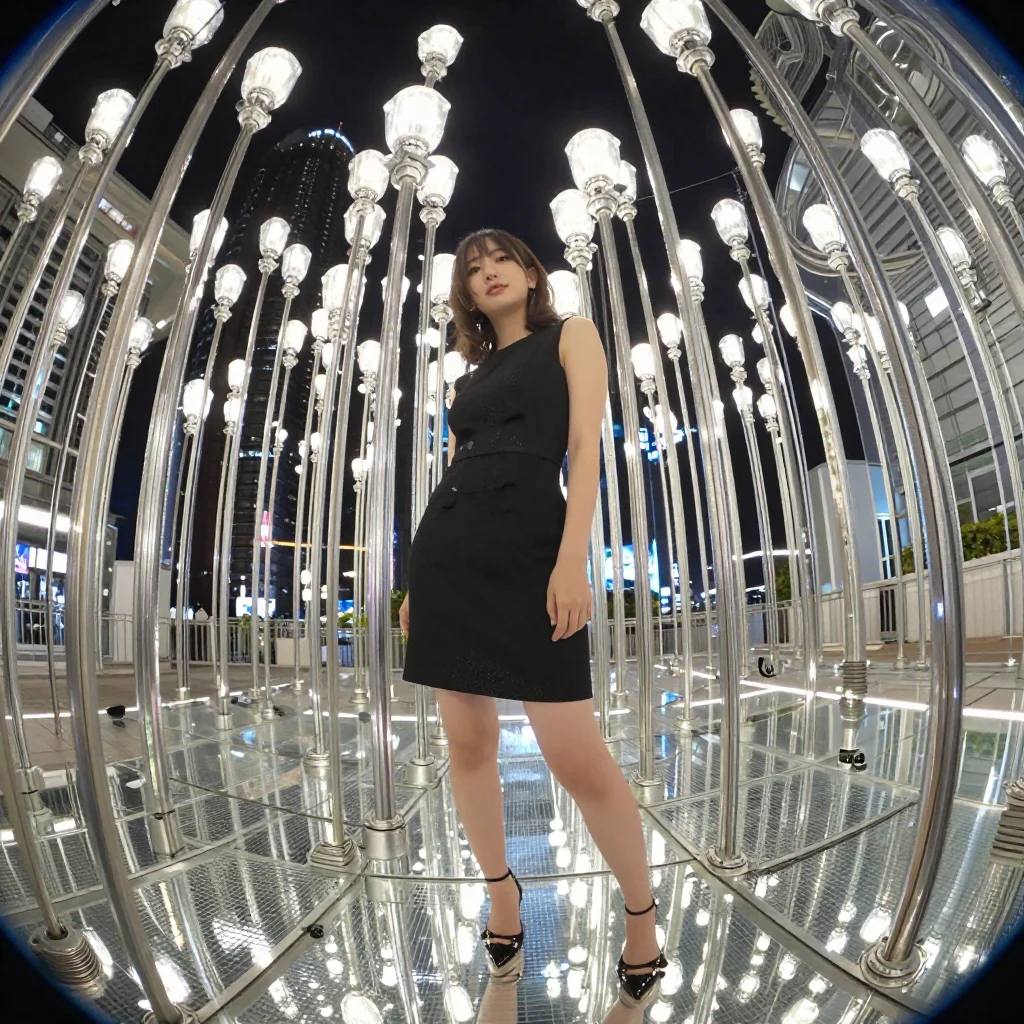 | 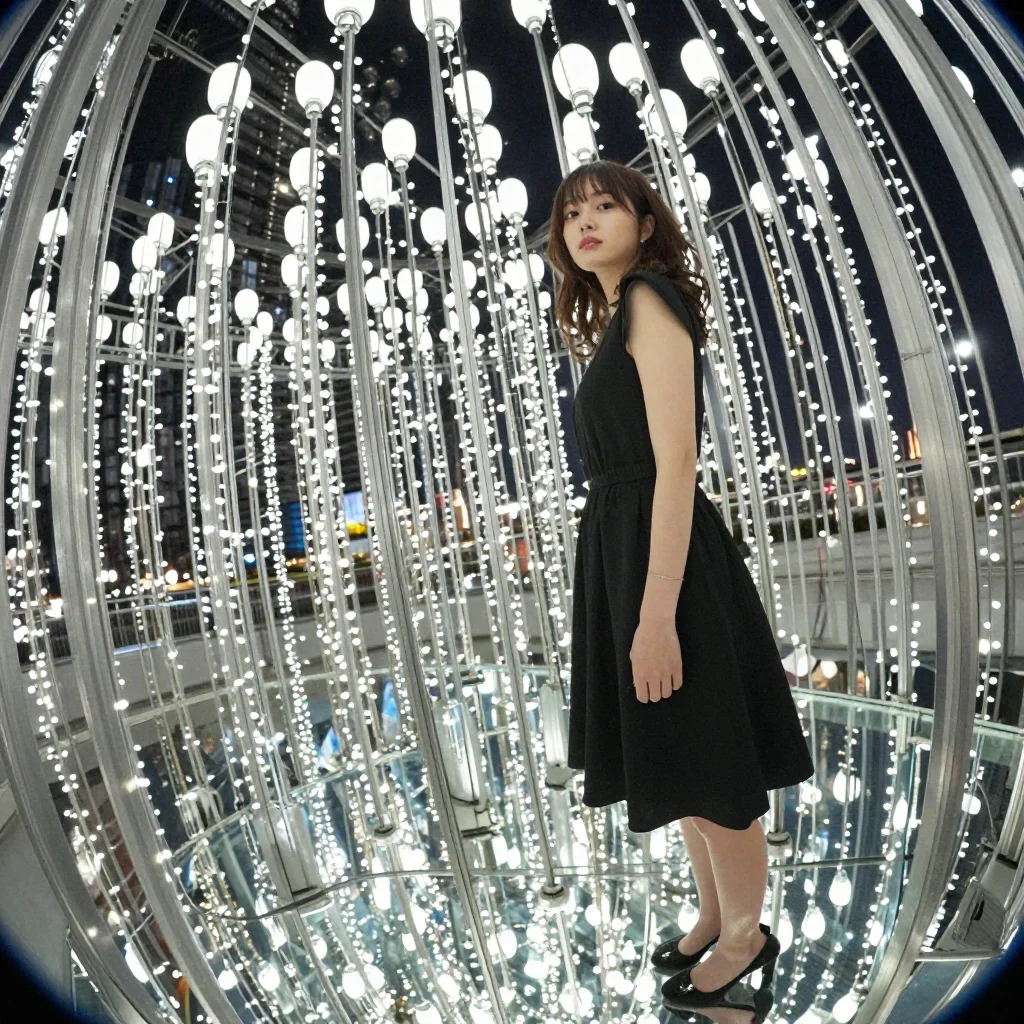 |
Observation: All 3 show circular barrel distortion across the entire frame with the fish eye effect clearly reproduced. Vignette darkening at the corners is also confirmed. All 3 consistently show the subject standing in an installation space with lined street lamp-type poles — changing from illumination avenues to spherical globe streetlight poles. s2 and s3 show the ground as a reflective material (mirror or glass) with the lighting reflected. Fish eye distortion effects are stably reproduced with a unique spatial expansiveness.
Summary
| Condition | Composition Change | Illumination Maintained | Notes |
|---|---|---|---|
| control | - | Tree lights | Baseline |
| low angle | Looking-up composition | Disappeared | Replaced by wall/ceiling lighting |
| high angle | Looking-down composition | Disappeared | Replaced by ground-embedded lights |
| dutch angle | No change | Maintained | Screen tilt doesn’t occur |
| from behind | Rear composition | Changed to tunnel type | Looking-back pose is stable |
| overhead | True overhead | Changed to garden lights | Subject lies down |
| through lights | Foreground bokeh | Maintained (bokeh-ified) | Full body ignored |
| fish eye | Barrel distortion | Changed to streetlight type | Vignette effect present |
Camera angle keywords reliably affect the composition itself, but dutch angle alone failed to function as screen tilt.
Meanwhile, when the angle is changed, the background illumination depiction tends to change significantly. What was illumination wrapped around trees in control changed to ceiling lighting with low angle, ground lights with high angle, tunnel structure with from behind, and streetlight installation with fish eye.
Through lights stably generates foreground bokeh but is difficult to combine with full body framing. Better suited for portrait-style use.
![[Verified] Image Generation Prompt Best Practices](/tips/prompt-best-practices/cover_0_0000_4517457392071889496.webp)
![[Experiment] Illumination × Close-Up to Bust-Up | 8 Conditions, 24 Images](/tips/illumination-close-angle-test/a04_fairy_lights_s2_0_0000_7295072554507705269.webp)