Key Takeaways
- Height keywords (
extremely tall woman/8 feet tall woman) could not produce a person larger than the surrounding buildings. 0 out of 15 images. The effect is limited to increased frame occupancy and elongated proportions. - The numeric
8 feet tall womanraised the head-to-body ratio in 3 out of 3 images, working slightly better than the adjective version. Still no giant. low angle shot from ground level, looking up at herdid not lower the camera (0 out of 3). Instead, in 3 out of 3 images the subject looked up at the sky. The model interpretedlooking upas the subject’s action.- The most Hachishaku-sama-like result came from the combined condition at seed 43. High frame occupancy + a slightly low viewpoint + a white-hatted woman gazing upward came together by chance.
- [Follow-up] The inverted approach — shrinking the town instead of enlarging the woman — worked in 3 out of 3 images. Specifying a half-scale miniature town reliably produces a “woman taller than the houses,” with rooftops at shoulder-to-chest height.
- [Follow-up 2] The diorama look that comes with the miniature directive can be overwritten with weathering vocabulary. Adding
weathered wood, aged mossy roof tiles, rusty gutters+documentary photographkept the giant scale (2 of 3) while restoring the texture of a real old town. Droppingminiature, by contrast, erases the scale itself.
This is the first entry in our yokai series. See also the Kuchisake-onna edition and the Yuki-onna edition.
The Hachishaku-sama Motif
Hachishaku-sama is an urban-legend yokai: a woman roughly 240 cm (8 shaku) tall who appears in a white dress and a wide-brimmed hat. As an image-generation subject, the motif breaks down into three elements:
- Height and intimidation — the subject of this test
- White dress + wide-brimmed hat — reliably achievable with clothing keywords
- A rural alley — reliably achievable with location keywords
The problem is element 1. With no other person in the frame for comparison, how do you express height at all? We test two axes: height keywords and camera angle.
Experiment Setup
| Item | Value |
|---|---|
| Model | z-image-turbo (6B, photorealistic distilled) |
| Steps | 8 |
| Sampler | euler / ddim_uniform |
| CFG | 1.0 |
| Size | 1024x1024 |
| Seeds | 42, 43, 44 (fixed) |
| Per condition | 3 images |
| Total | (5 main + 8 follow-up conditions) × 3 = 39 images |
Base Prompt
Conditions
| Condition | Change | Variable type |
|---|---|---|
| A00: Control | None | — |
| A01: tall | Add extremely tall woman | Height adjective |
| A02: 8ft | Add 8 feet tall woman | Numeric height |
| A03: lowangle | Add low angle shot from ground level, looking up at her | Camera angle |
| A04: combo | A01 + towering over the viewer + A03 together | Combined |
Since A04 adds multiple elements at once, we make no claims about individual causal effects there.
The follow-up group (B) was added later based on the main results, using the same seeds 42, 43, 44.
| Condition | Change | Variable type |
|---|---|---|
| B01: 2.5m | Add 2.5 meters tall woman | Numeric height (meters) |
| B02: window | Add her head level with the second floor windows of the houses | Environment-based height |
| B03: mini | Change the setting to a half-scale miniature japanese town, small old wooden houses and utility poles built at half size, rooftops reaching her shoulder height | Environment scale |
The second follow-up group (C) has five conditions aimed at removing the diorama look that came with B03’s giant scale. Same seeds 42, 43, 44.
| Condition | Change | Intent |
|---|---|---|
| C01: minilow | B03 + low angle | Fix the high-angle camera |
| C02: lowtown | Drop the miniature vocabulary: old japanese town with low single-story wooden houses, weathered tiled rooftops reaching her shoulder height, aged walls and rusty gutters | Describe a real, low-built town |
| C03: lowtown_la | C02 + low angle | Combined |
| C04: minireal | B03 + weathered wood, aged mossy roof tiles, rusty gutters + eye level shot, documentary photograph | Keep miniature, overwrite texture with weathering |
| C05: aboveroof | C02 base + her head and shoulders rising above the weathered tiled rooftops | State the person-to-roof relation directly |
Results by Condition
A00: Control
| seed 42 | seed 43 | seed 44 |
|---|---|---|
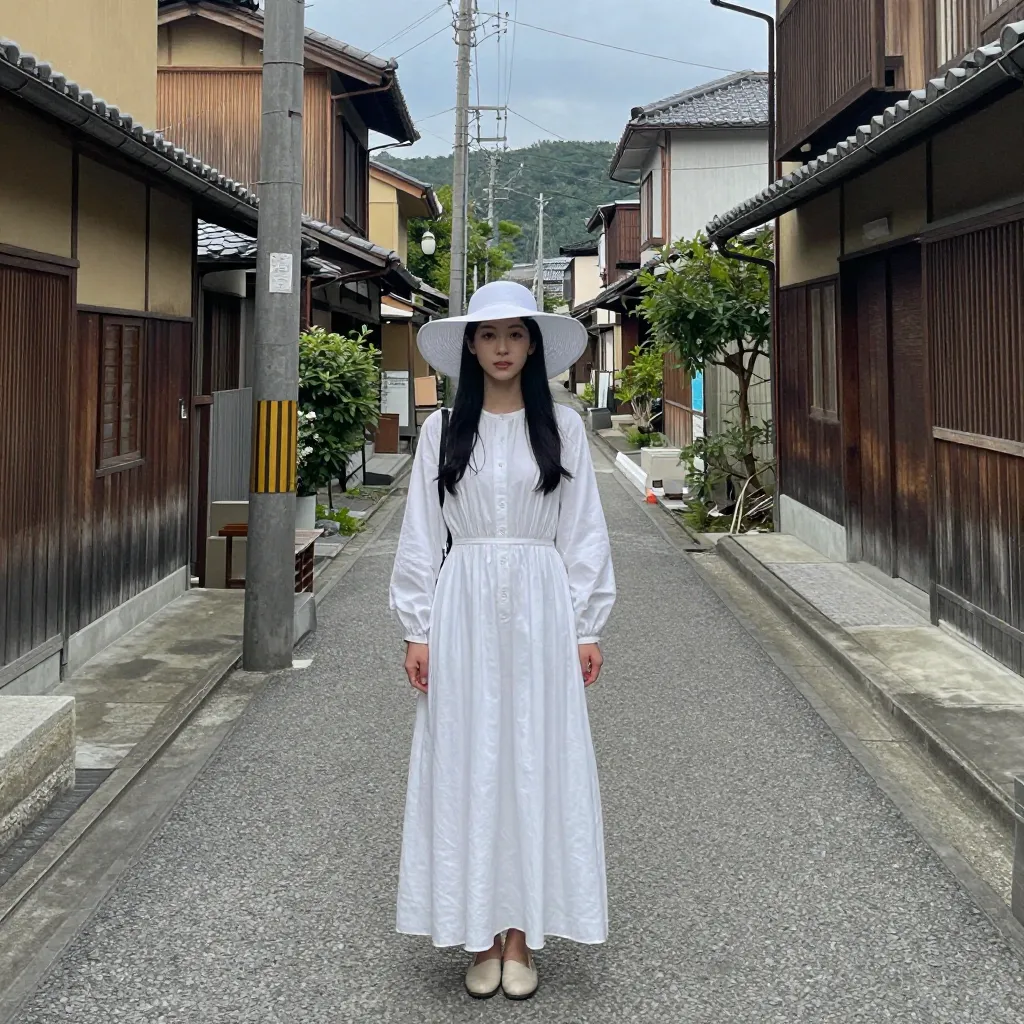 | 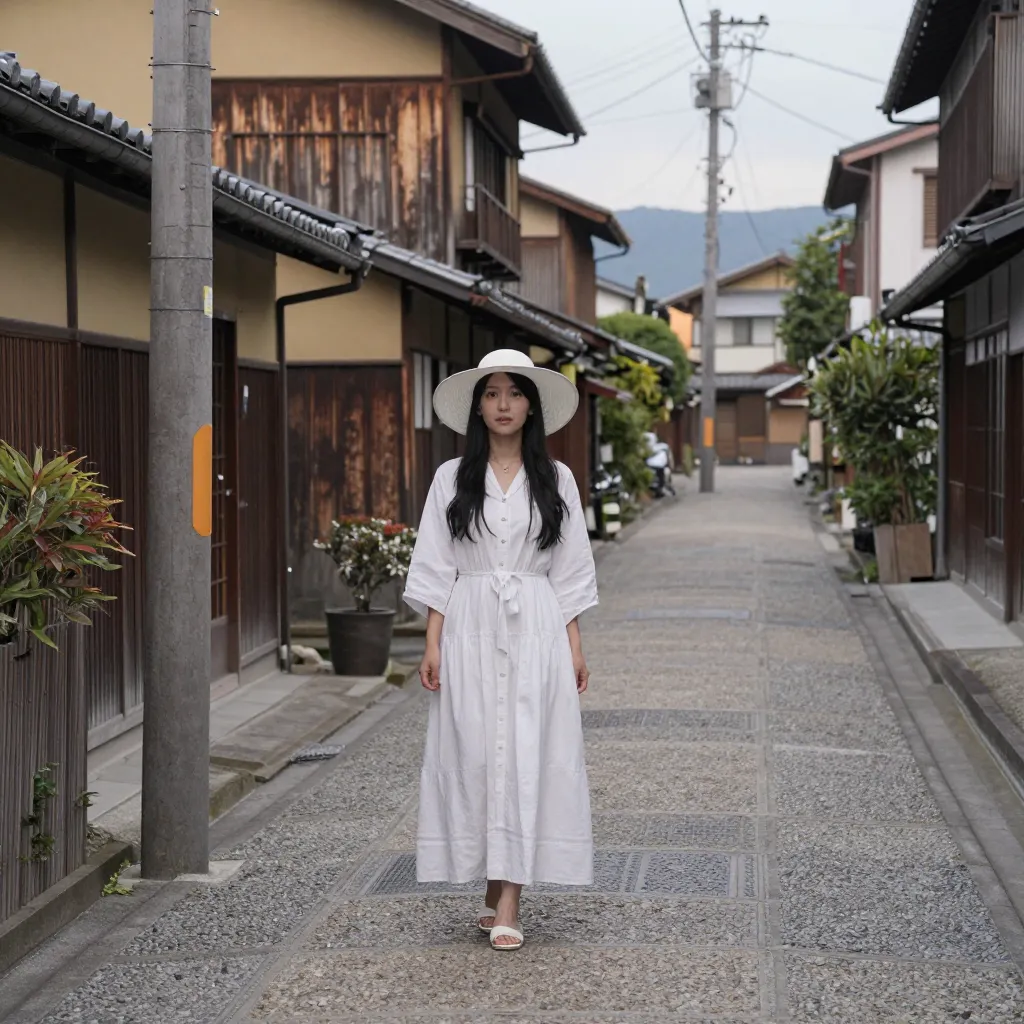 | 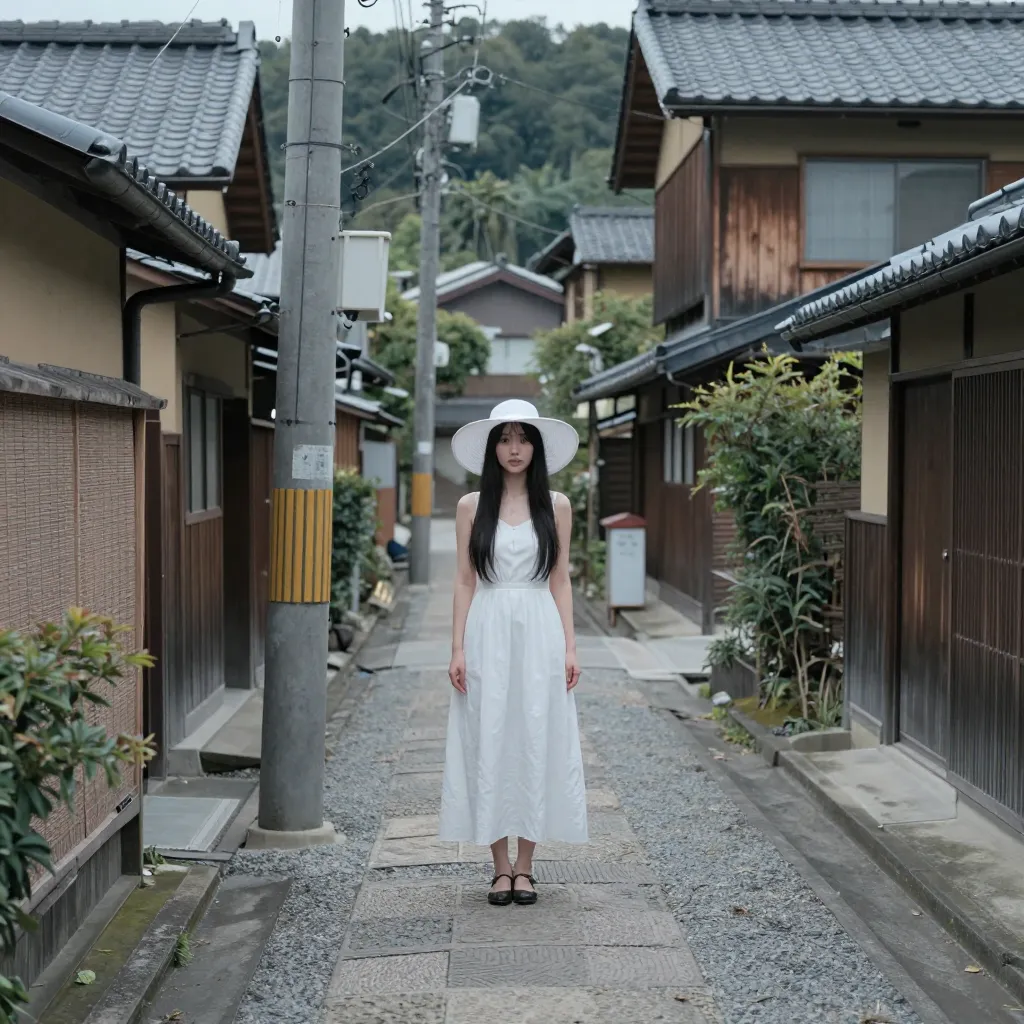 |
Observations: All three images show a woman in a white dress and white hat standing in an alley of old wooden houses — scene fidelity is high. Height is average in all three and the camera stays at eye level. Seed 42 gives a frontal centered composition, seed 43 a walking pose, and seed 44 a wider full-body shot.
A01: extremely tall woman
| seed 42 | seed 43 | seed 44 |
|---|---|---|
 | 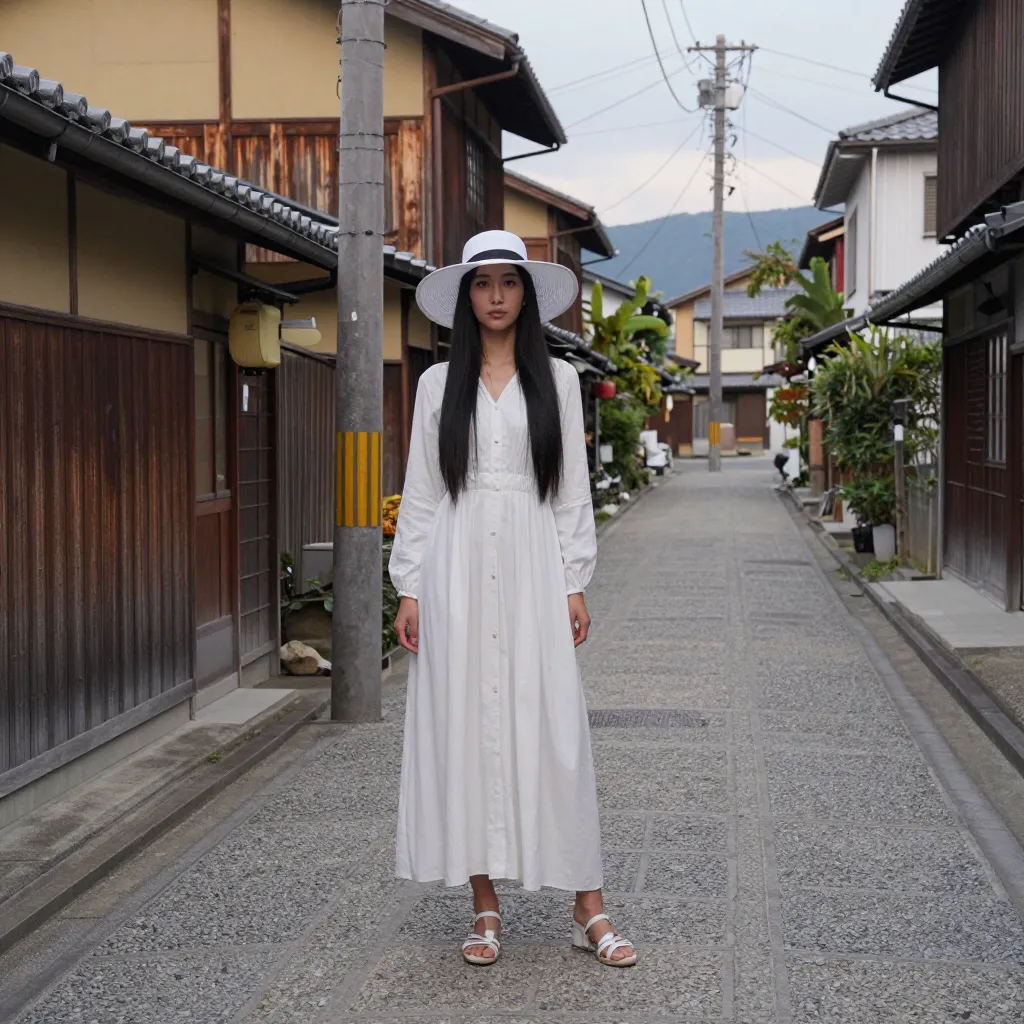 |  |
Observations: In 2 out of 3 images (seeds 42, 43) the subject occupies more of the frame than the control, with a longer torso and legs. Relative to the houses and utility poles, however, she remains within normal human height — no “large person” effect. Seed 44 stays close to the control’s wide composition, with platform sandals added.
A02: 8 feet tall woman
| seed 42 | seed 43 | seed 44 |
|---|---|---|
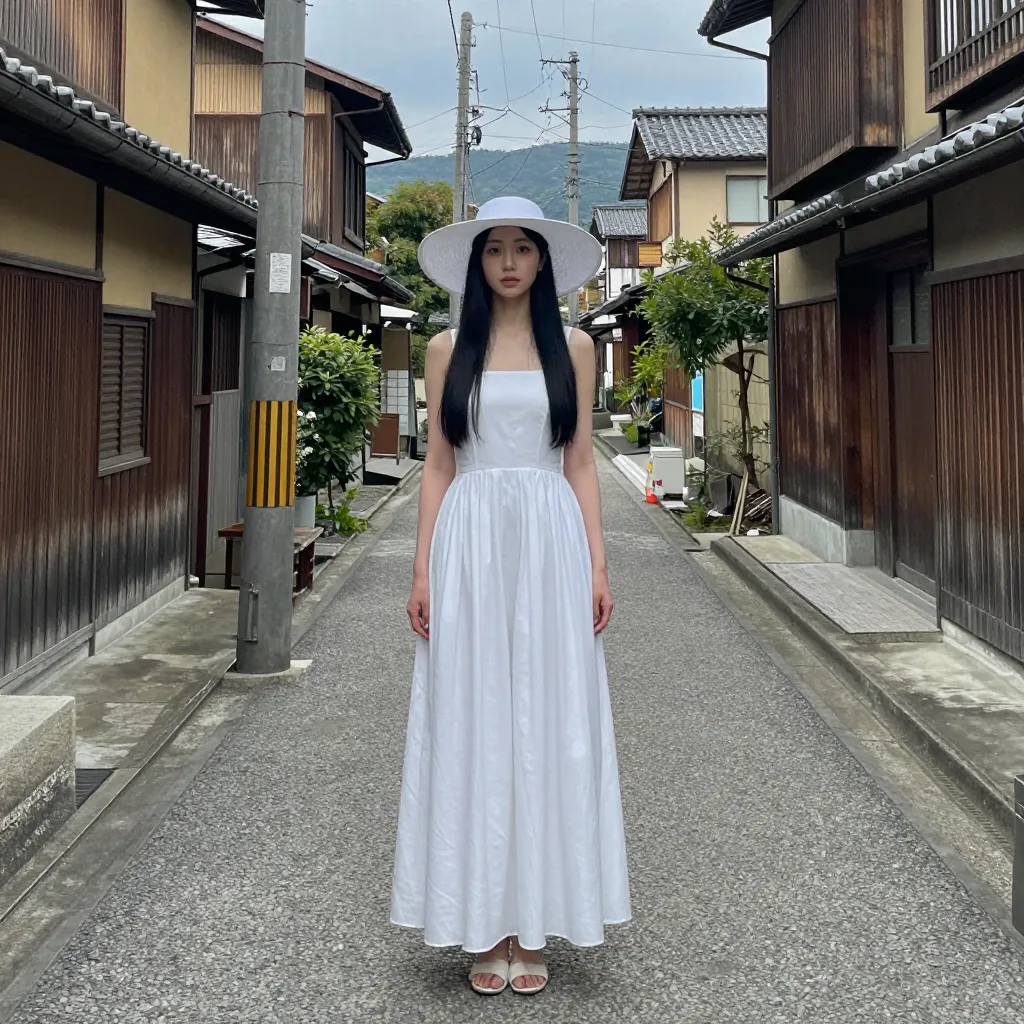 | 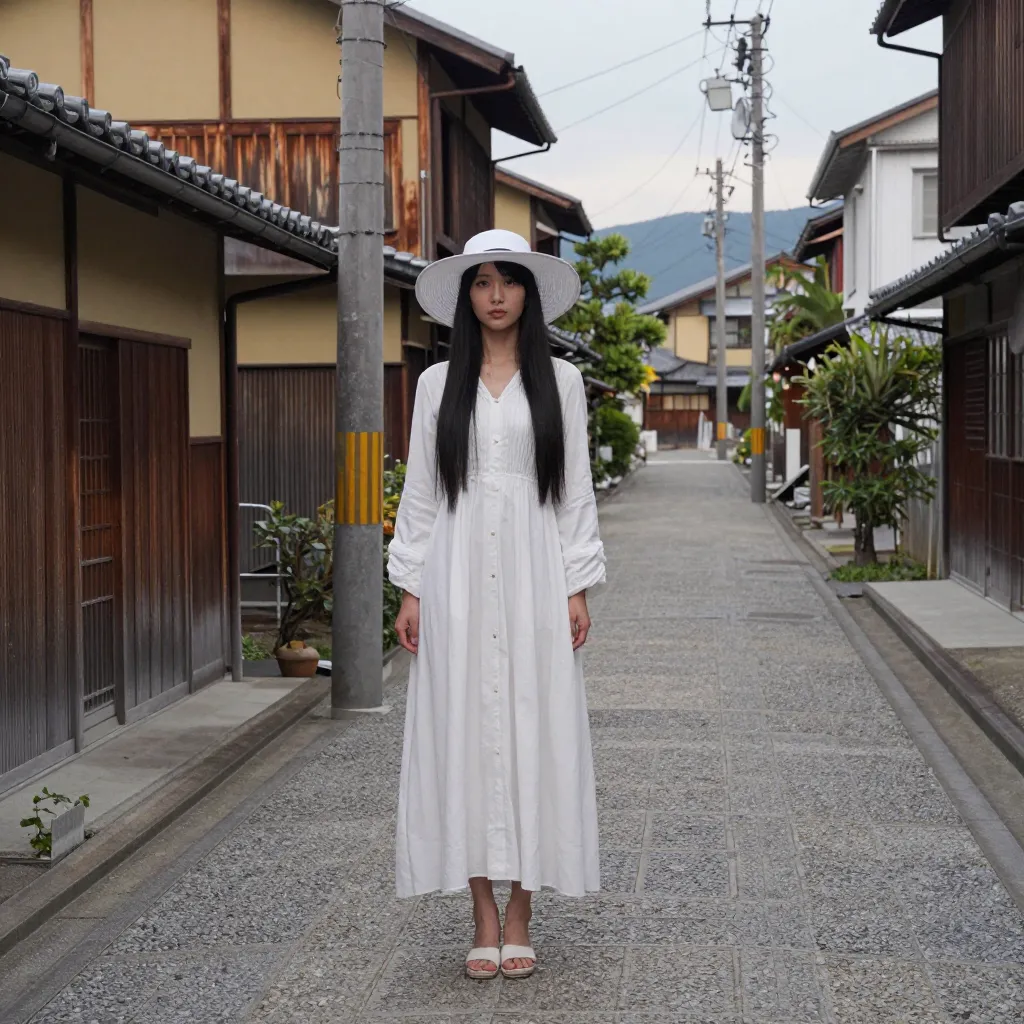 | 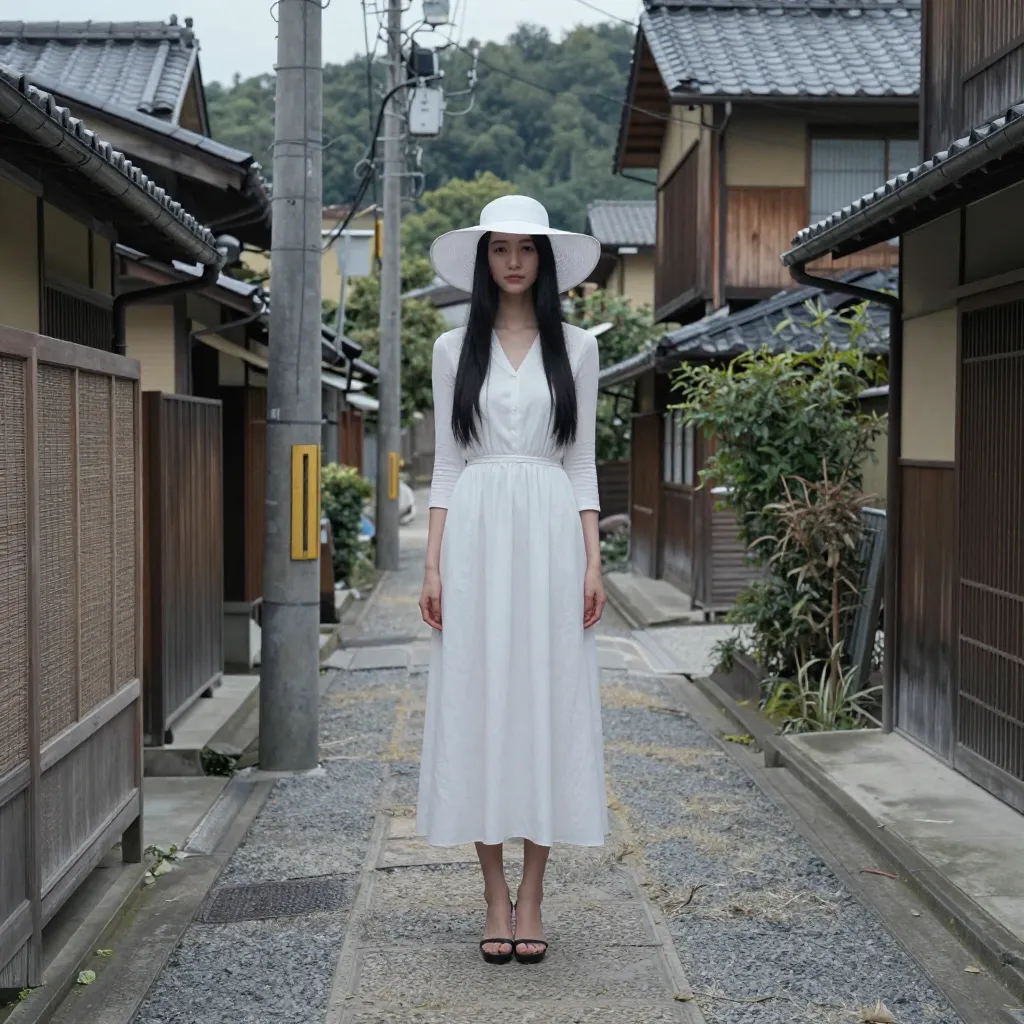 |
Observations: All three images show elongated proportions (seed 44 approaches nine heads tall with a notably small head) and a larger subject within the frame. The change is more consistent than with the adjective extremely tall. Still, 0 out of 3 images depict her as larger than the buildings. As a side effect the outfit changed: seed 42 produced a sleeveless camisole dress and seed 44 three-quarter sleeves.
A03: Low-Angle Directive
| seed 42 | seed 43 | seed 44 |
|---|---|---|
 |  |  |
Observations: An unexpected result. The camera position dropped in 0 out of 3 images; instead, in 3 out of 3 the subject raises her face and looks up at the sky. The viewpoint phrase “looking up at her” appears to have been applied as the subject’s own action. In our camera angle comparison, a bare low angle lowered the camera in 3 out of 3 images, so the failure here may come down to phrasing (no direct same-scene comparison exists, so we won’t state this conclusively).
A04: Everything Combined
| seed 42 | seed 43 | seed 44 |
|---|---|---|
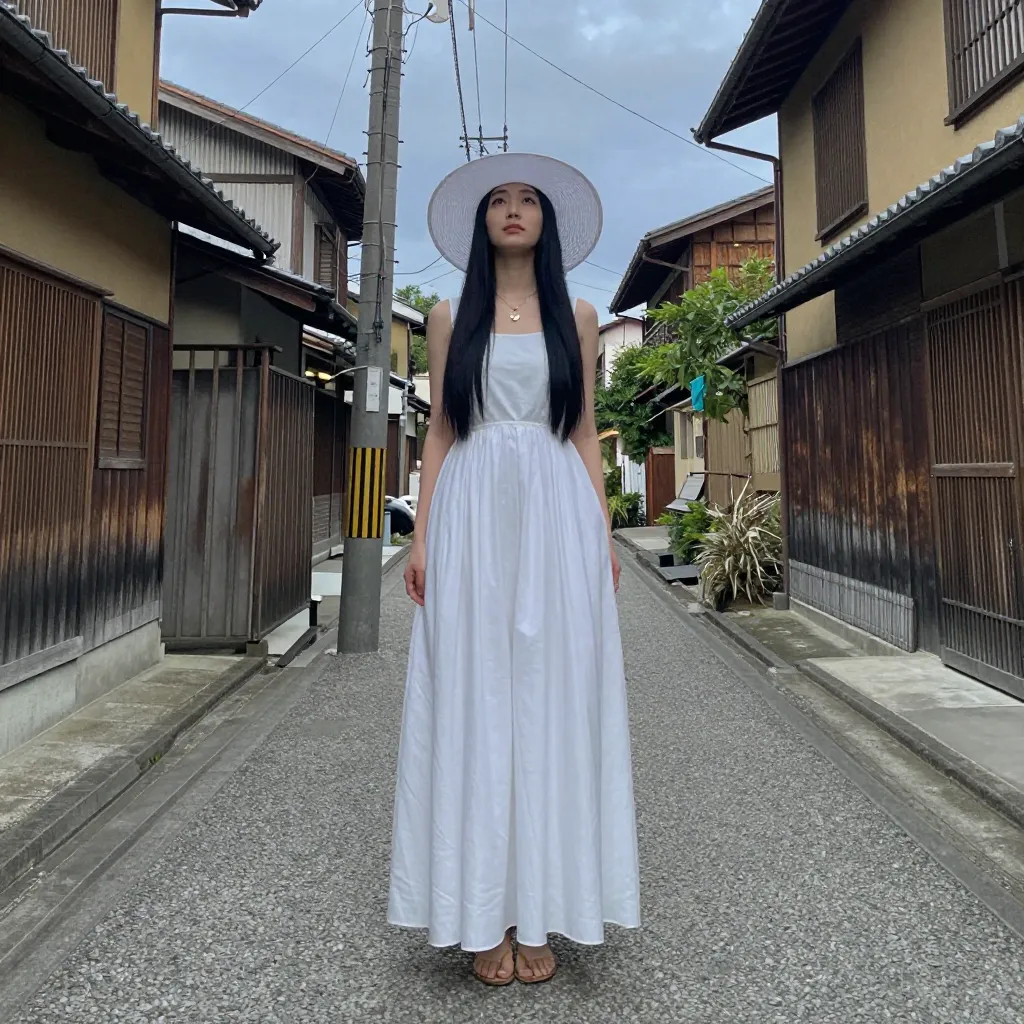 |  | 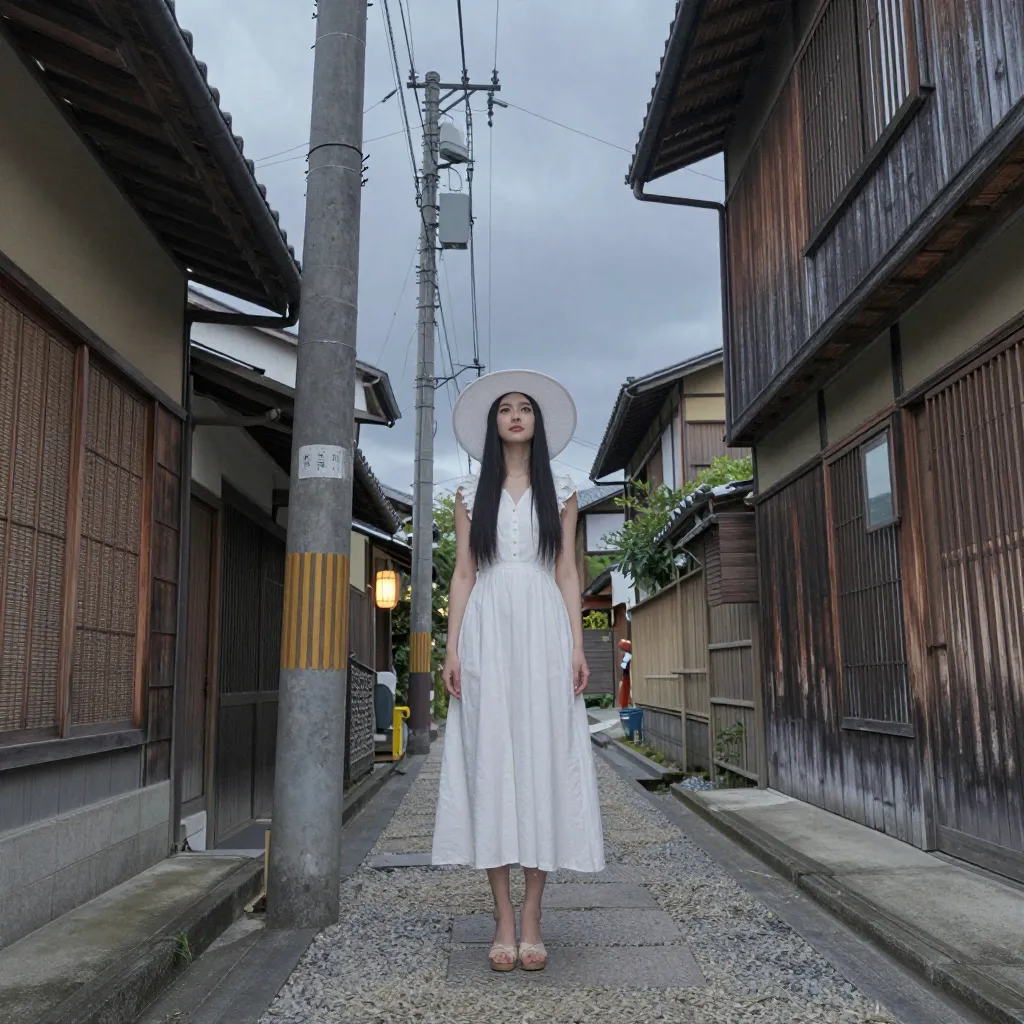 |
Observations: Once again the subject looks upward in 3 out of 3 images. However, seeds 42 and 43 show a large jump in frame occupancy, and seed 43 — with a viewpoint from around knee height, nearly nine-head proportions, and a white-hatted woman gazing upward — is the most intimidating, Hachishaku-sama-like image of all 15. Seed 44 returns to normal size, with outfit changes such as ruffled sleeves.
Follow-up: Meters, Environment References, and a Miniature Town
B01: 2.5 meters tall woman
| seed 42 | seed 43 | seed 44 |
|---|---|---|
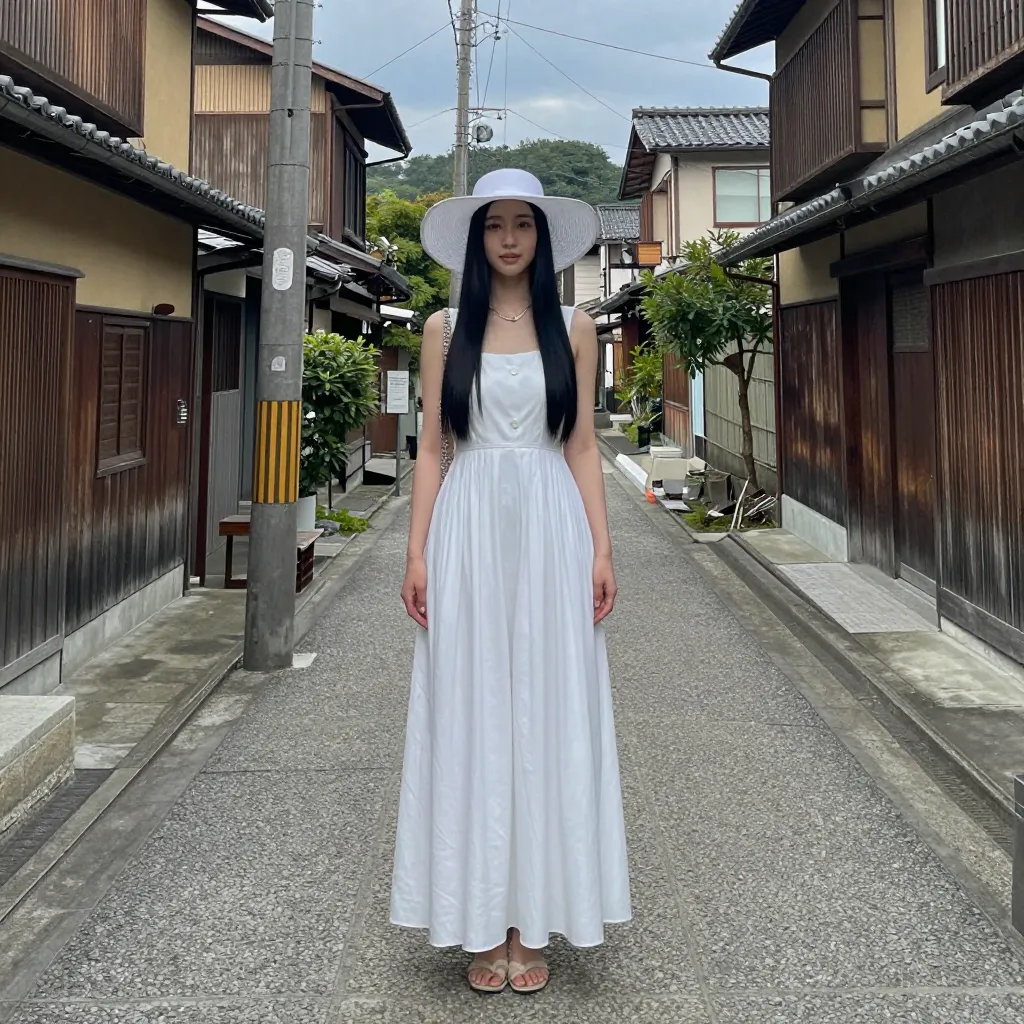 |  |  |
Observations: Metric numbers behave like the feet-based numbers (A02). All three raise frame occupancy and head-to-body ratio, but she stays within normal height relative to the houses — “larger than the buildings” appears in 0 out of 3. As side effects, seed 42 shifted to a bright daytime scene with a sleeveless dress.
B02: Head Level with the Second-Floor Windows
| seed 42 | seed 43 | seed 44 |
|---|---|---|
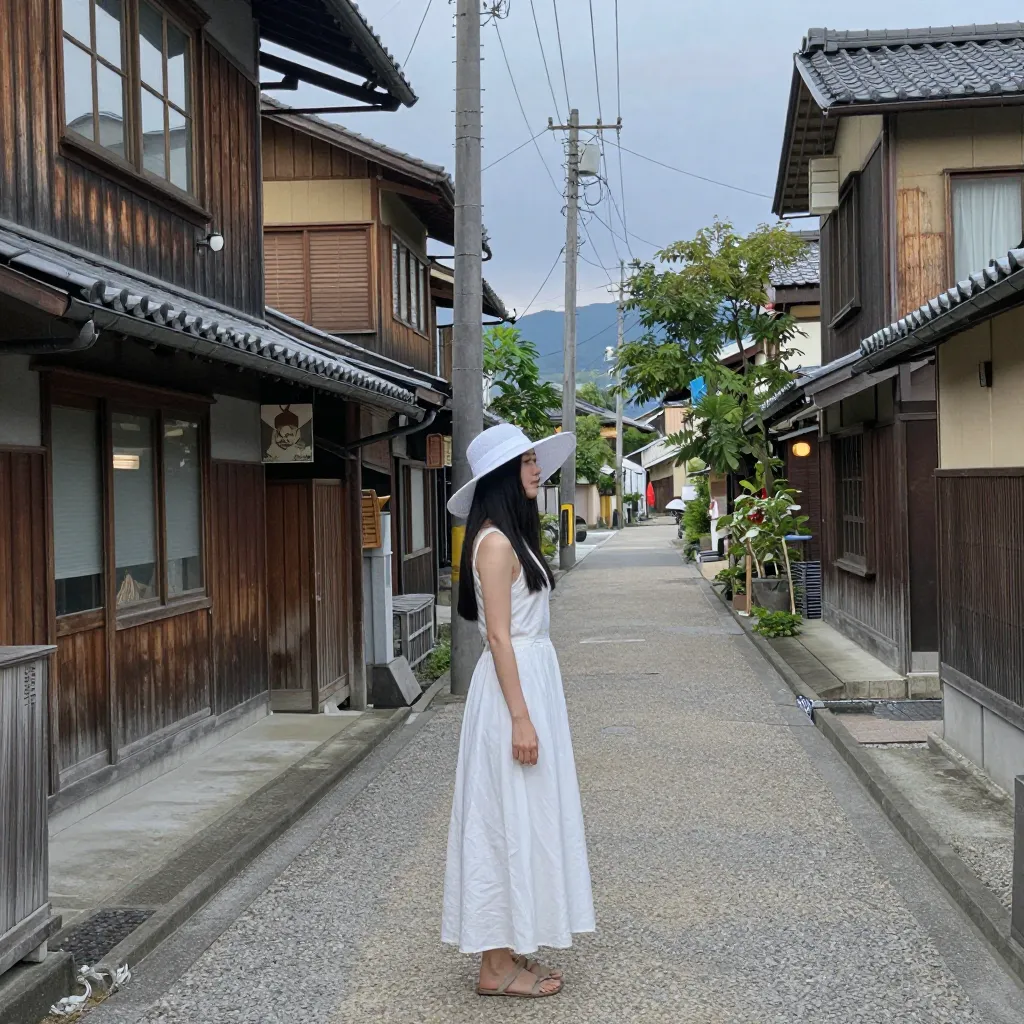 | 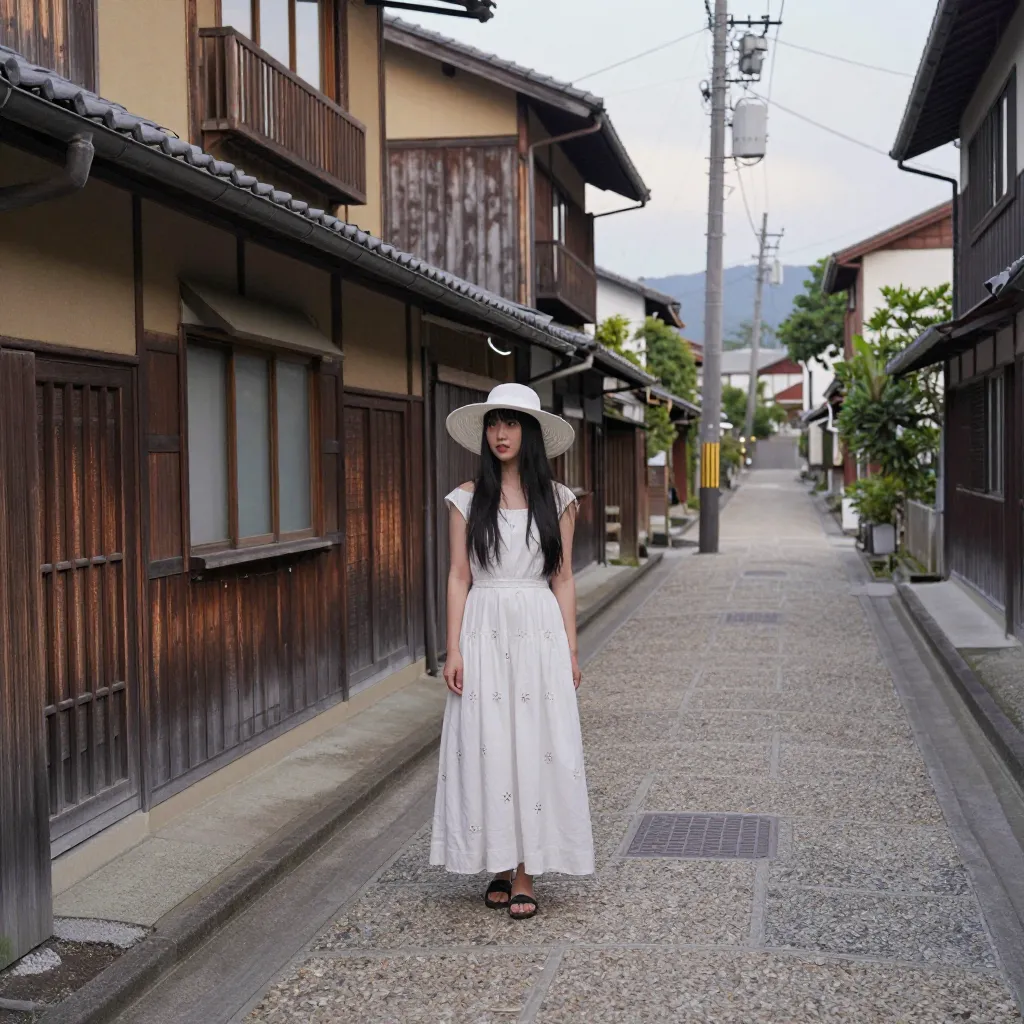 | 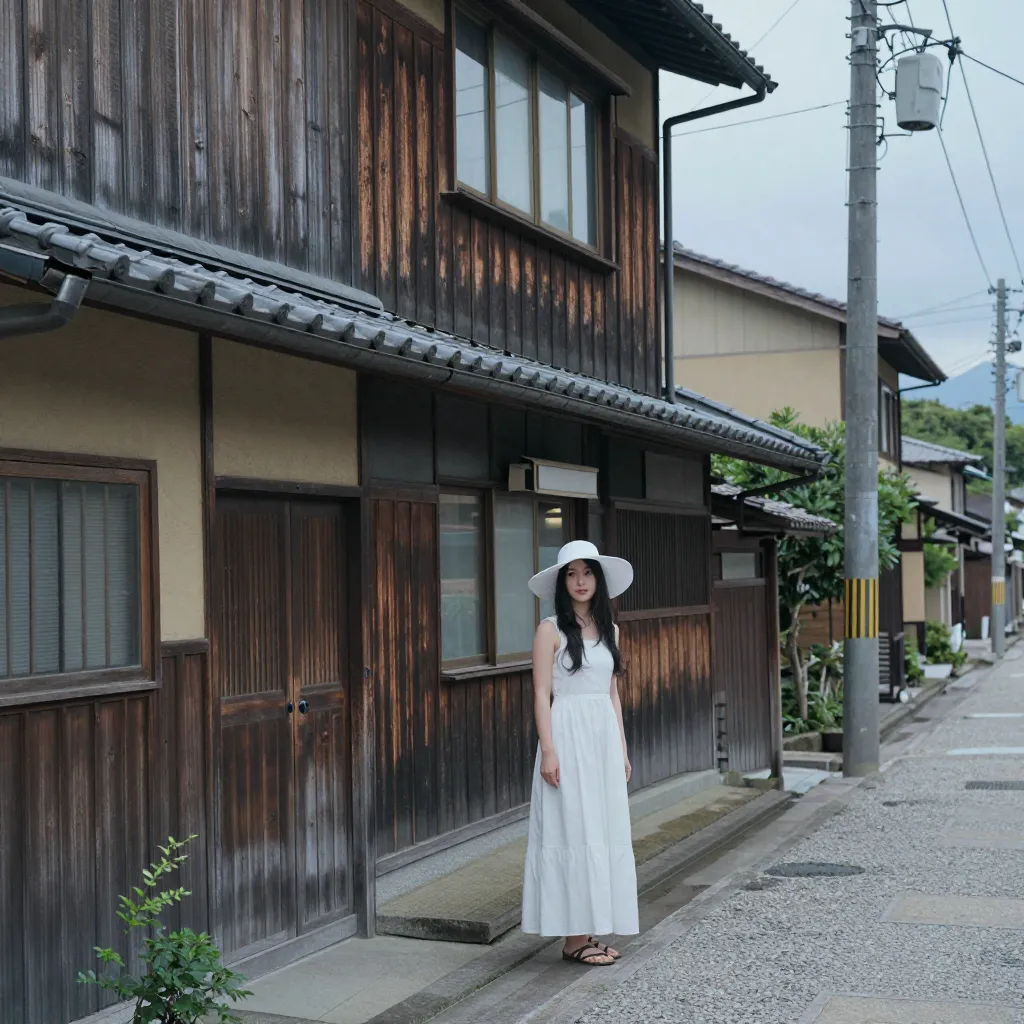 |
Observations: The environment-based directive was reflected in her height in 0 out of 3 images. Instead, in 2 out of 3 (seeds 42, 44) the composition changed so that second-floor windows appear prominently in the frame. The phrase “second floor windows” seems to have been interpreted as an element to include in the picture, not as a size reference.
B03: Half-Scale Miniature Town
| seed 42 | seed 43 | seed 44 |
|---|---|---|
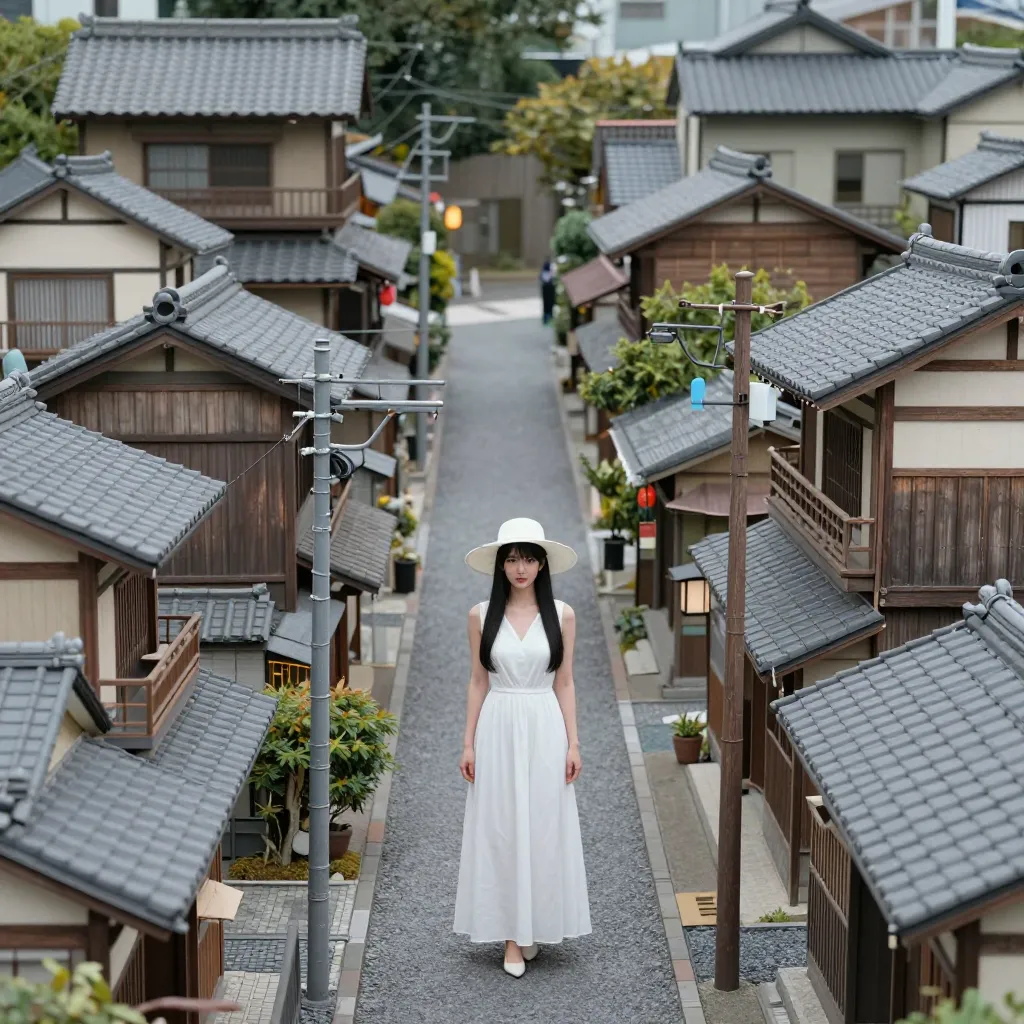 |  | 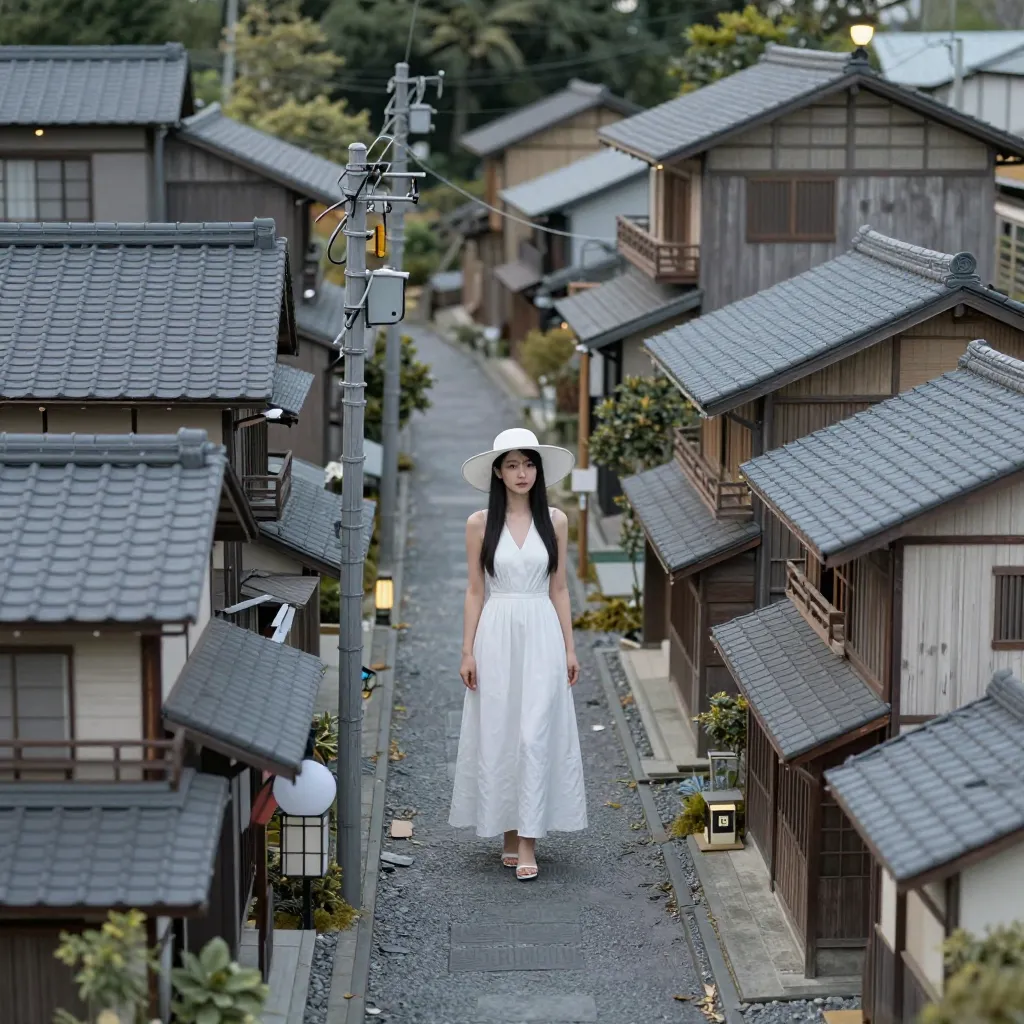 |
Observations: The only condition in this article where “a woman taller than the houses” holds. In 3 out of 3 images the surrounding houses are drawn smaller than her, with rooftops roughly at waist-to-shoulder height. The inversion — lowering the world’s scale rather than raising the person’s — works. Side effects: all three take a slightly high-angle camera, and the buildings acquire a diorama look (uniform roof tiles, overly tidy layout). Whether it reads as “a giant woman in a real town” or “a woman standing in a miniature town” varies between images.
Follow-up 2: Removing the Diorama Look
We split B03’s diorama look into two suspected causes — the high-angle camera and the texture prior of the word miniature — and isolated them across five conditions.
C01: Miniature + low angle
| seed 42 | seed 43 | seed 44 |
|---|---|---|
 |  |  |
Observations: low angle failed in 0 of 3 — the camera stays elevated. The giant scale itself holds in all three, and so does the diorama look (seed 43 leans slightly more real). The same low angle that worked 3 of 3 at the poolside in our camera angle comparison doesn’t get through in this scene — possibly pulled by a strong miniature-overhead composition prior (speculation).
C02: Described as a Real, Low-Built Town
| seed 42 | seed 43 | seed 44 |
|---|---|---|
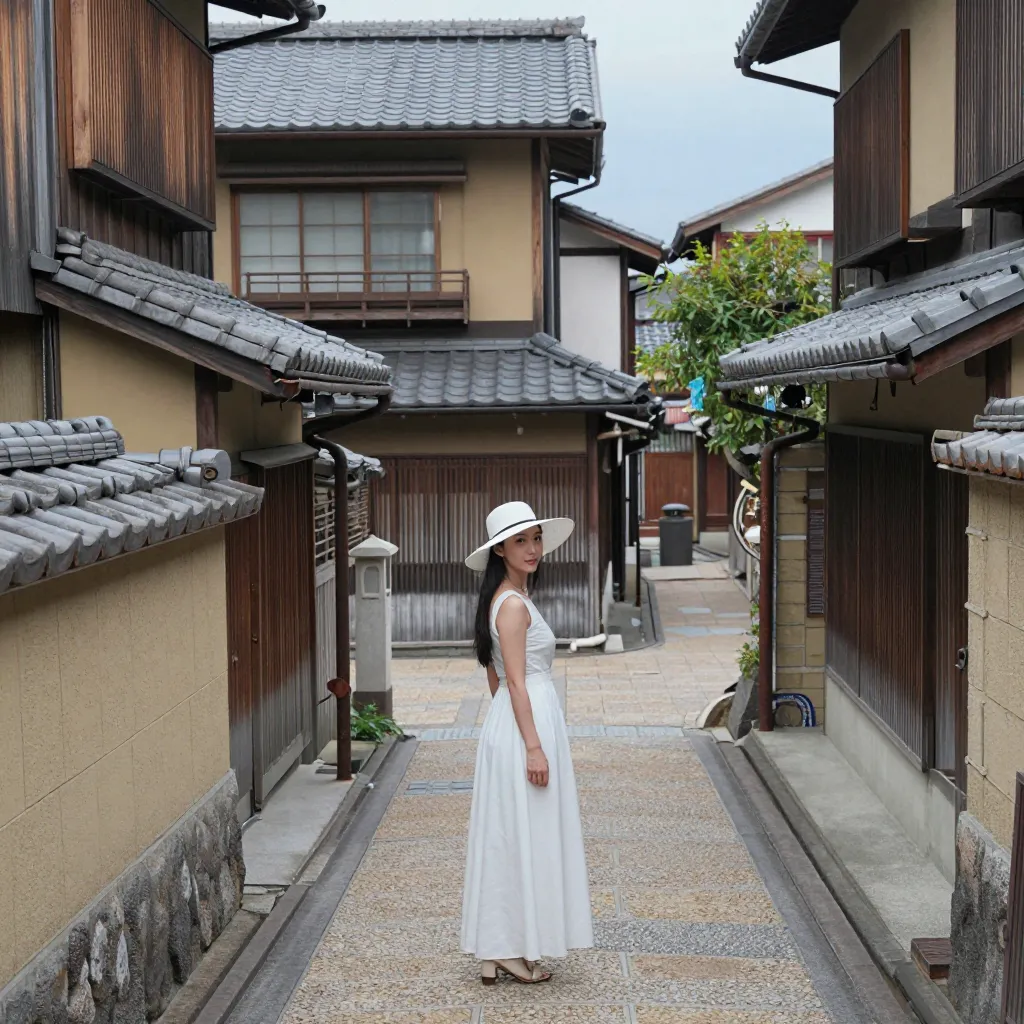 |  | 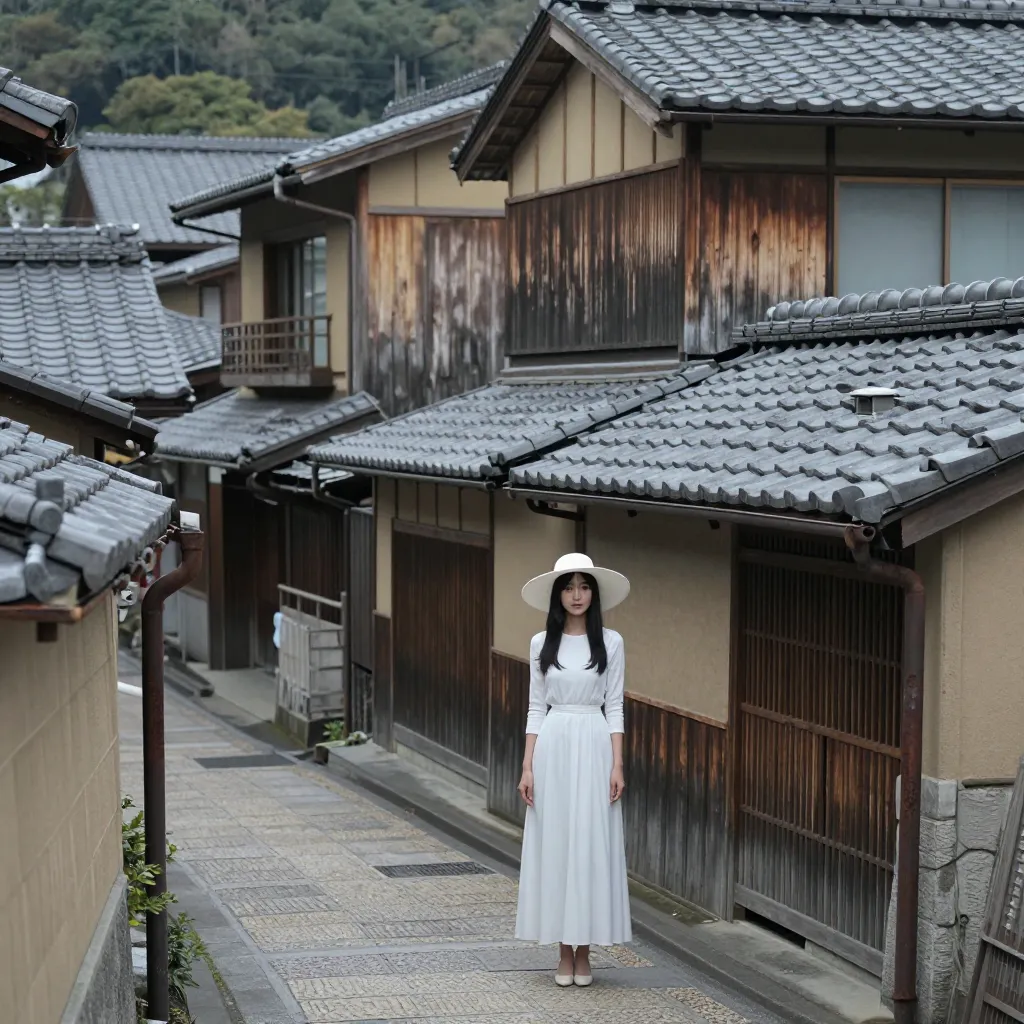 |
Observations: Realism fully returns in 3 of 3 — weathered wood and rusty gutters, a genuine-looking old townscape. The trade: the scale effect disappears. “Rooftops at shoulder height” appears in 0 of 3; she’s back to normal height. Dropping the miniature vocabulary drops the scale with it.
C03: C02 + low angle
| seed 42 | seed 43 | seed 44 |
|---|---|---|
 |  |  |
Observations: Same tendency as C02 — a real town at normal scale. low angle fails here too (0 of 6 total in this alley scene).
C04: Keep Miniature, Overwrite the Texture with Weathering
| seed 42 | seed 43 | seed 44 |
|---|---|---|
 | 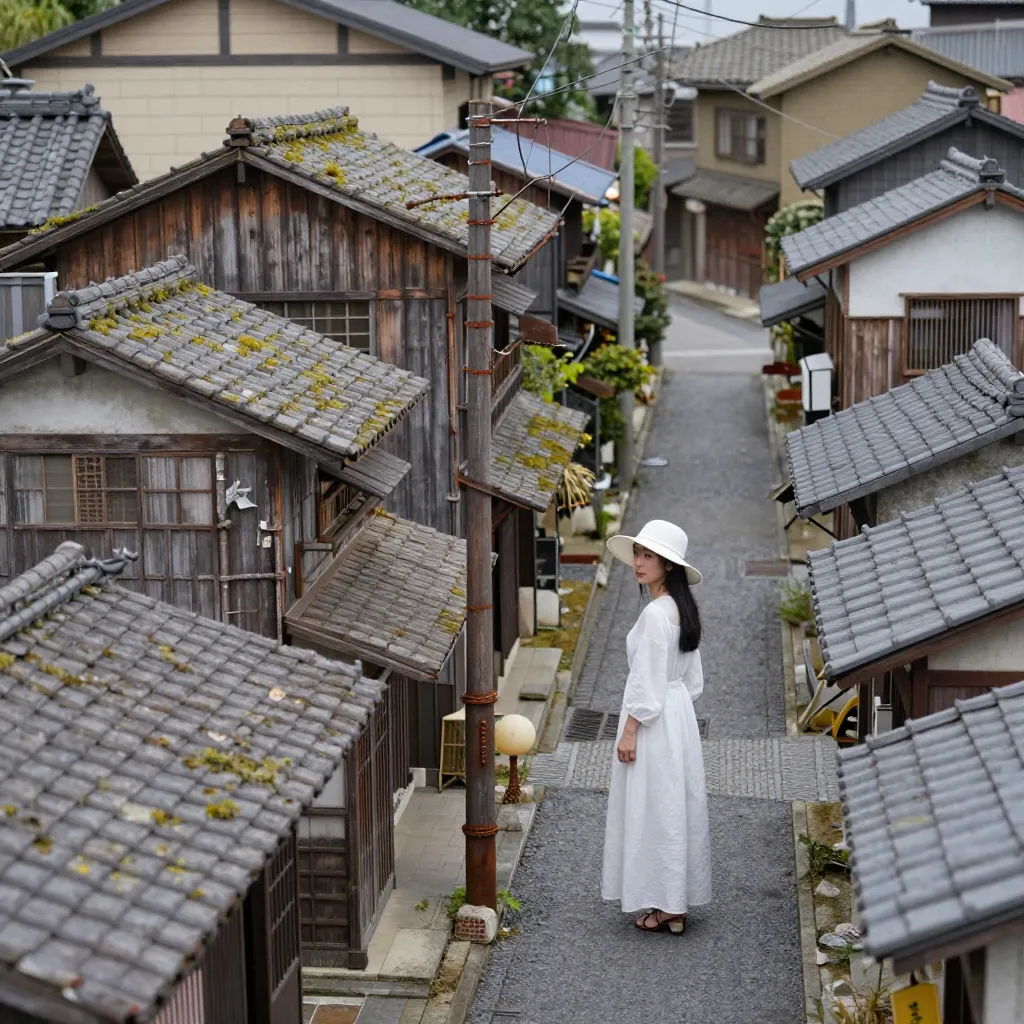 |  |
Observations: The winning condition of follow-up 2. In 3 of 3 images the tiles grow moss, the wood weathers, and the poles rust — the texture of a real old town. B03’s diorama look (uniform tiles, overly tidy layout) is gone. The giant scale holds at seeds 42 and 43 (eaves at waist-to-chest height); seed 44 weakens toward normal height. eye level shot doesn’t work and the camera stays elevated, but looking down across mossy rooftops incidentally serves the image of “a being who overlooks the town.”
C05: Stating the Person-to-Roof Relation Directly
| seed 42 | seed 43 | seed 44 |
|---|---|---|
 | 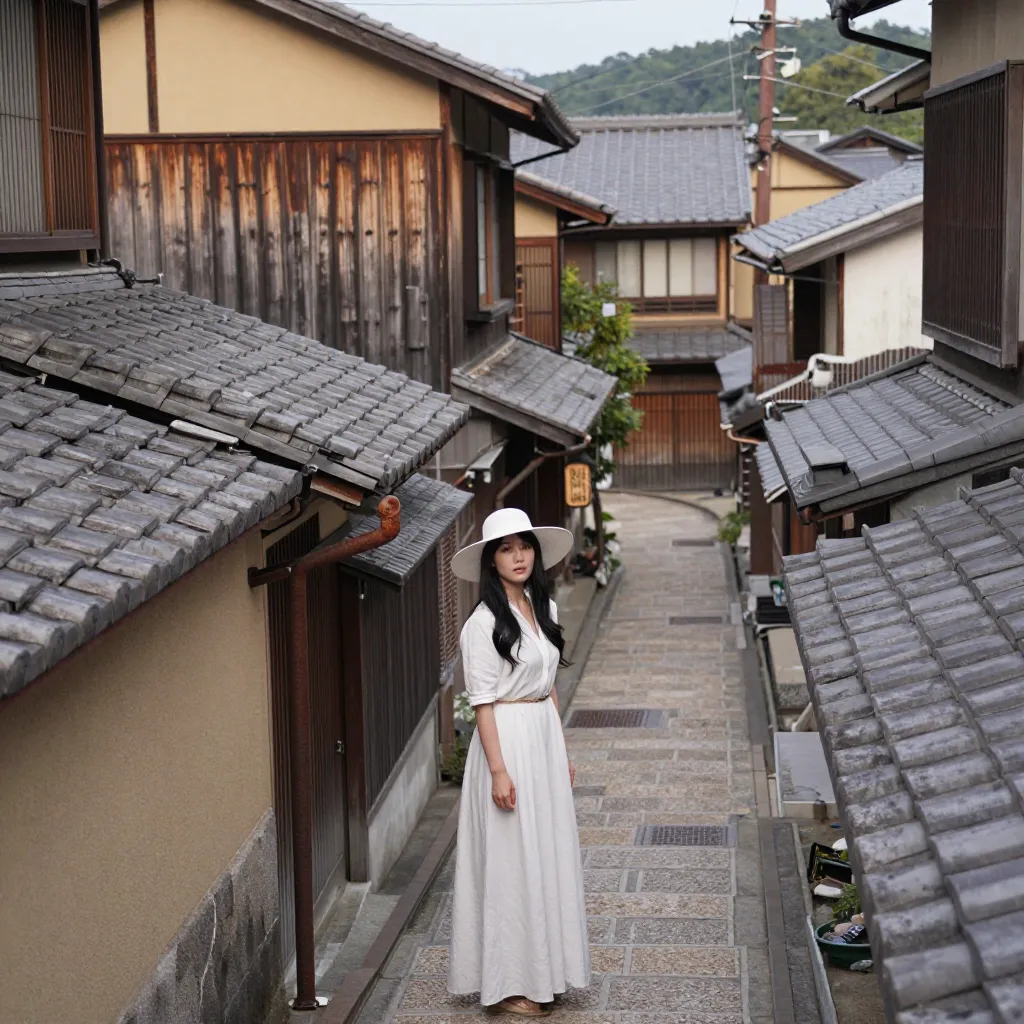 | 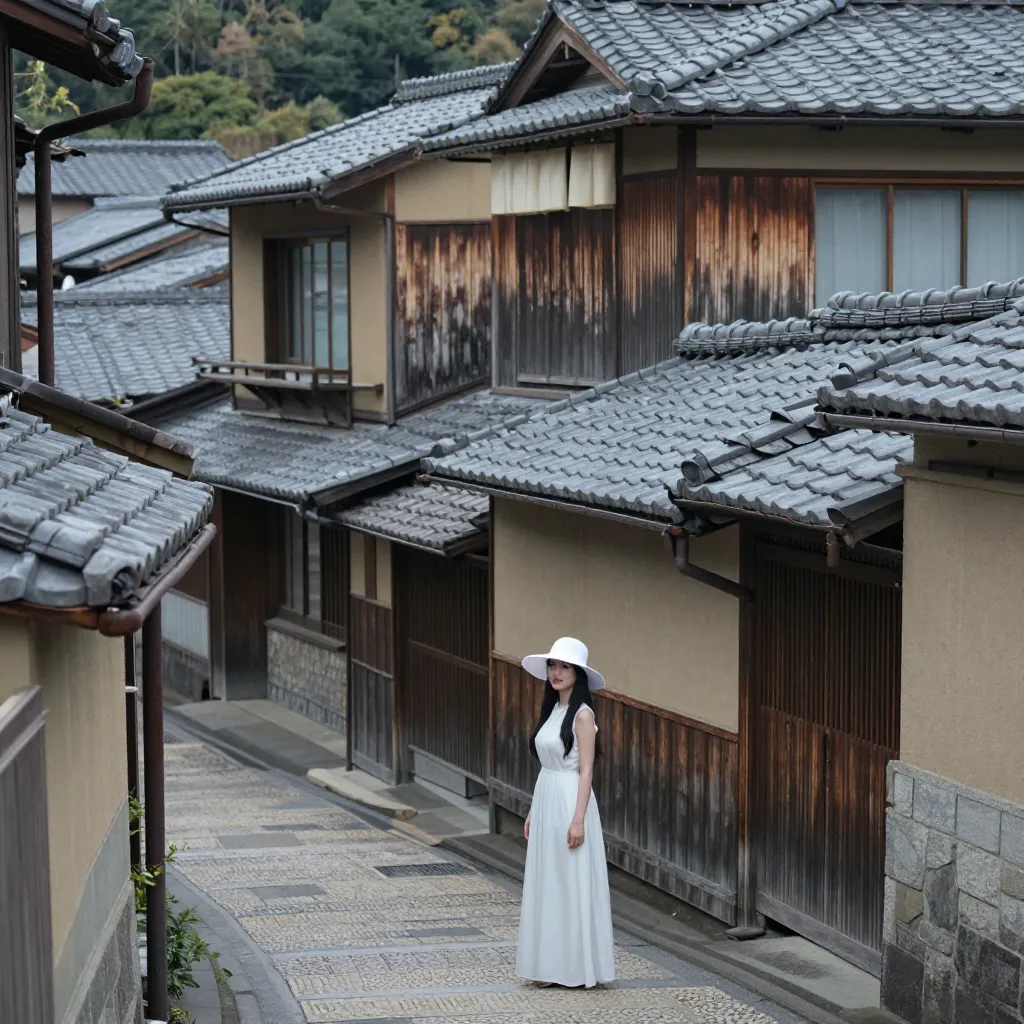 |
Observations: “Her head and shoulders rising above the rooftops” is ignored in 3 of 3, yielding a normal-height woman in a real townscape. As with B02 (second-floor windows), size relations between person and buildings don’t get through in a real-town context.
Cross-Condition Comparison (seed 43)
| Control | 8 feet tall | Everything combined |
|---|---|---|
| | |
Frame occupancy and head-to-body ratio increase from left to right, but none of them depict her as larger than the buildings.
Discussion
Relative height is hard to express in a single image
Height keywords manifested as proportion changes (more heads tall) and increased frame occupancy, not as a size change relative to the buildings and poles. Changing units (feet → meters) or anchoring to the environment (second-floor windows) didn’t alter this tendency. Whether placing a second person in the frame changes this is a topic for future testing.
If you can’t enlarge the person, shrink the world
The only approach that worked (follow-up B03) specified the environment as a half-scale miniature rather than touching the person at all. Relative size seems unavailable as “a big person” but perfectly available as “small buildings + a normal person.” For a “being larger than the town” like Hachishaku-sama, this is currently the shortest route.
The diorama look belongs to “miniature” — counter it with weathering details
Follow-up 2’s isolation showed the diorama look is the texture the word miniature brings along (uniform tiles, overly tidy layout, prop-like lighting). Remove miniature and the texture heals but the scale dies (C02, C05). What worked was C04: keep miniature, explicitly add decay — weathered wood, aged mossy roof tiles, rusty gutters — plus documentary photograph. Real-old-town texture and giant scale coexisted in 2 of 3 images. Scale vocabulary and texture vocabulary can be controlled separately.
The giant-scale recipe (current conclusion)
Build the scale with “a miniature town,” then pull the texture back to reality with weathering details. That two-step is the conclusion across all 39 images. Camera directives (low angle / eye level shot) failed in 0 of 9 images in this composition.
Keep viewpoint directives short
looking up at her turned into the subject’s upward gaze in 6 out of 6 images (A03 + A04). Phrases with ambiguous ownership tend to bind to the subject. If you just want a lower camera, the previously verified bare low angle is currently the safe choice.
A practical recipe for Hachishaku-sama
Rather than specifying height directly, combining “numeric height for proportions + higher frame occupancy + a low angle” to make her look big is the realistic approach. Our best image (A04 seed 43) is an accidental success of exactly that combination; making it reproducible is the next challenge.
Note: Not what we asked for, but the three images of white-hatted women all gazing up at the sky in a deserted alley are unsettling in their own right. In a horror context, the “looking up” misinterpretation may have its uses.
Summary
| Method | Height effect | Side effects |
|---|---|---|
extremely tall woman | Slight frame-occupancy increase (2 of 3) | Outfit details change |
8 feet tall woman | Elongated proportions (3 of 3), no giant (0 of 3) | Outfit becomes sleeveless, etc. |
low angle shot from ground level, looking up at her | Camera lowered in 0 of 3 | Subject looks up (3 of 3) |
| Everything combined | Large frame-occupancy increase (2 of 3) | Upward gaze (3 of 3) |
2.5 meters tall woman | Proportions/occupancy up, no giant (0 of 3) | Daytime shift, outfit change (1 of 3) |
| Head level with 2F windows | Height unchanged (0 of 3) | 2F windows enter the frame (2 of 3) |
| Half-scale miniature town | “Taller than the houses” in 3 of 3 | High-angle camera, diorama texture |
Miniature + low angle | Scale holds (3 of 3) | low angle ineffective, diorama remains |
| Real low-built town | Scale lost (0 of 3) | None (realism fully returns) |
| Miniature + weathering details | Scale holds (2 of 3) + real texture (3 of 3) | Camera stays elevated |
| Head above rooftops (relation) | No effect on scale (0 of 3) | None |
![[Tested] Can You Generate Kuchisake-onna? Mask On/Off Pairs and 3 Slit-Mouth Phrasings on the Same Seed](/tips/kuchisake-onna-mask-expression-test/c01_lacer_s1.webp)
![[Experiment] 6 Camera Angle Comparison — How Does a Poolside Scene Change with Low Angle, Bird's Eye, and Dutch Angle?](/tips/camera-angle-comparison/cover.webp)
![[Verified] Image Generation Prompt Best Practices](/tips/prompt-best-practices/cover_0_0000_4517457392071889496.webp)