How well does the prompt “dress made entirely of [flower] petals” work for replacing clothing with flowers? This test compares three flower types — cherry blossom, rose, and lily — to examine differences in petal size, coverage, and visual texture.
Test Conditions
| Parameter | Value |
|---|---|
| Model | z-image-turbo |
| Seeds | 42, 77, 123 (3 images per condition) |
| Variable | Clothing portion of the prompt only |
| Fixed elements | Subject, pose, background, lighting |
Only the clothing portion of the base prompt was changed across conditions.
The four conditions tested:
| Condition | Clothing Prompt |
|---|---|
| Control | elegant white dress |
| Cherry Blossom | dress made entirely of cherry blossom petals |
| Rose | dress made entirely of red rose petals |
| Lily | dress made entirely of white lily petals |
Control: Standard Dress
| seed 42 | seed 77 | seed 123 |
|---|---|---|
 |  |  |
All 3 images produced a plain white A-line dress. The dresses are sleeveless, below-the-knee length, with a smooth fabric texture. Backgrounds feature lush Japanese-style gardens, and the body is fully covered in all cases.
Test 1: Cherry Blossom Petal Dress
| seed 42 | seed 77 | seed 123 |
|---|---|---|
 |  |  |
All 3 images produced a dress densely packed with cherry blossom petals. The dress silhouette remained A-line, similar to the control. The petals are small and numerous, creating a layered pink-and-white texture.
Notably, in 3 out of 3 images the background shifted to cherry blossom trees, despite the background prompt remaining “garden.” The “cherry blossom” attribute leaked into the environment, with petals scattered on the ground as well. Body coverage was comparable to the control, with minimal skin exposure.
Note: The background being pulled into a cherry blossom motif is an attribute leak, but the result reads as cohesive – the scattered petals on the ground visually integrate with the dress.
Test 2: Rose Petal Dress
| seed 42 | seed 77 | seed 123 |
|---|---|---|
 |  | 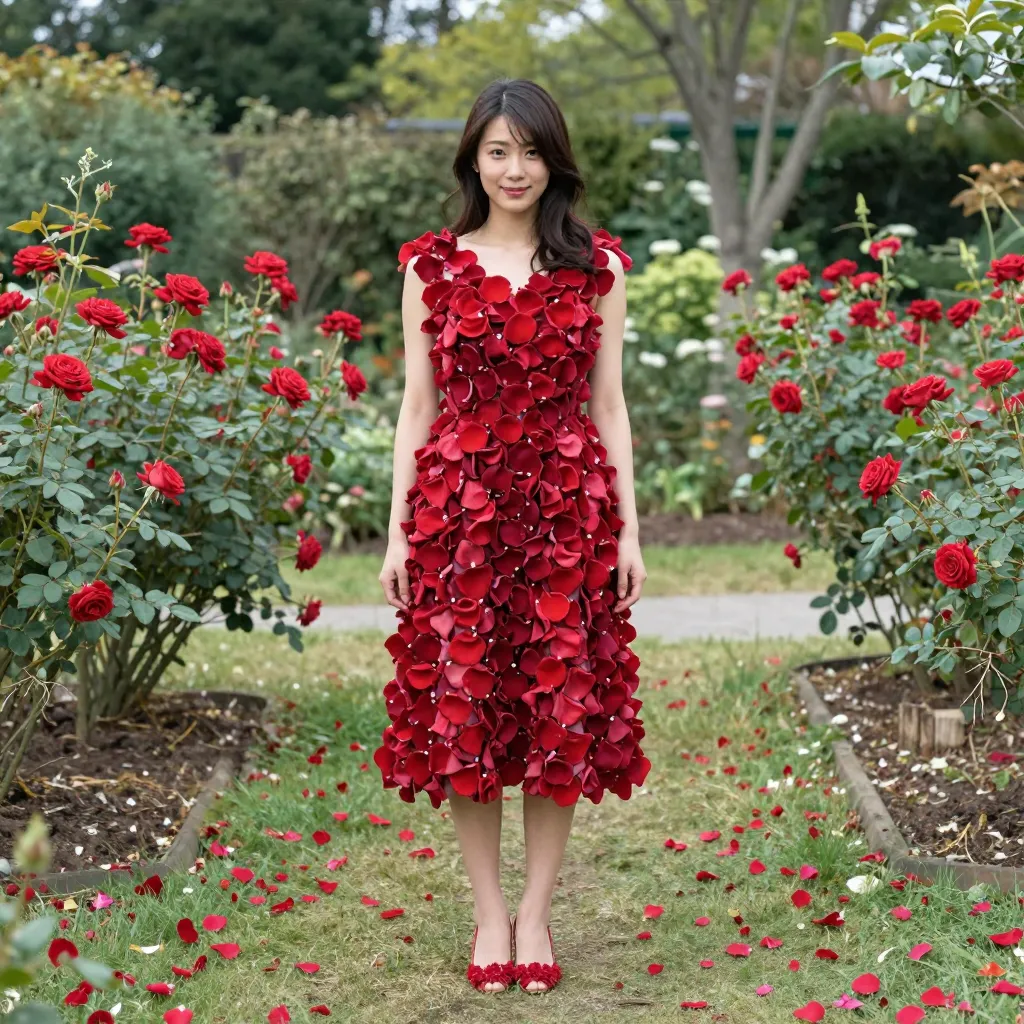 |
All 3 images produced a dress composed of deep red rose petals. The petals are individually larger than cherry blossoms, creating a layered, scale-like structure.
Dress length varied: seed 42 produced an above-the-knee dress, while seeds 77 and 123 resulted in longer, ankle-length gowns. As with the cherry blossom condition, 3 out of 3 backgrounds shifted to rose gardens with scattered petals on the ground.
Rose petals are thicker than cherry blossoms, resulting in denser coverage with virtually no gaps. The vivid red color creates strong contrast compared to the white control dress.
Test 3: Lily Petal Dress
| seed 42 | seed 77 | seed 123 |
|---|---|---|
 |  | 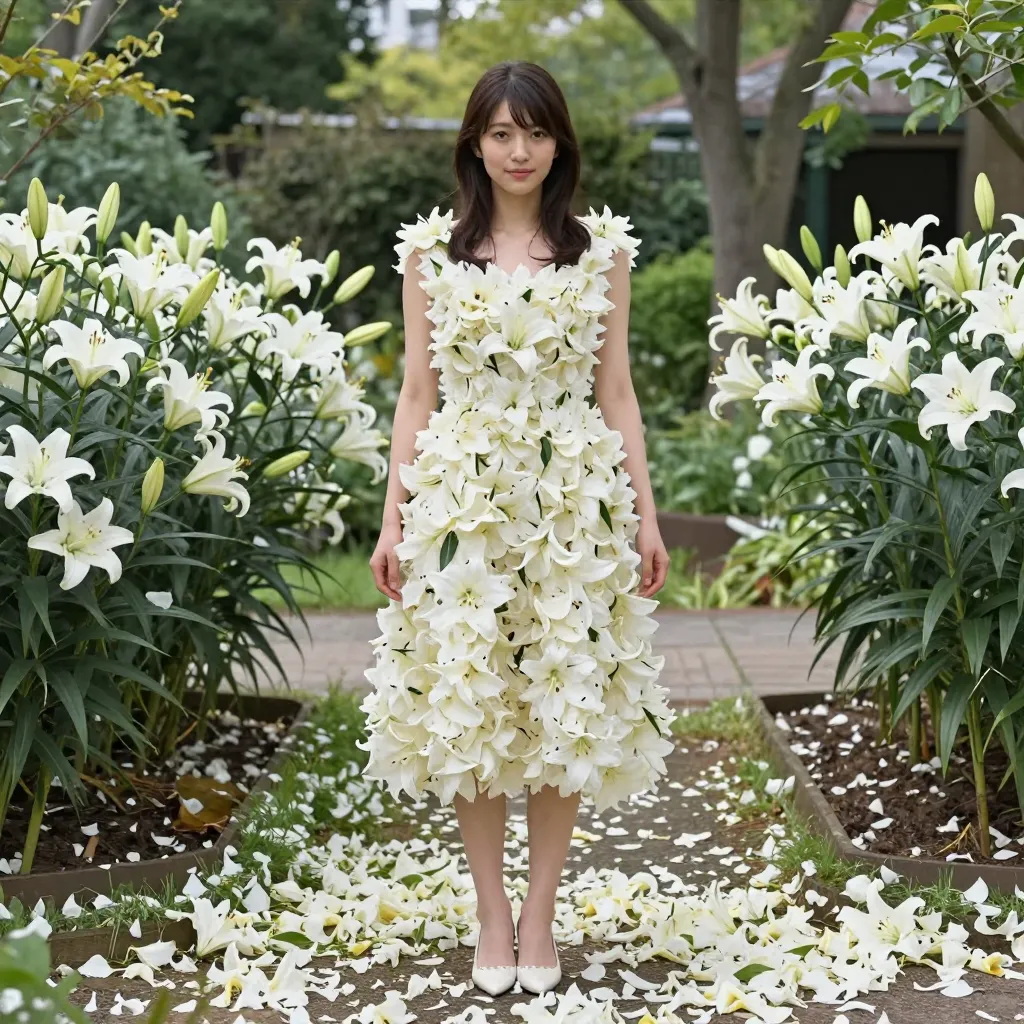 |
All 3 images produced a dress made of white lily flowers. Since lilies are significantly larger than cherry blossoms or roses, individual flowers are clearly visible in the dress structure.
Due to the large flower size, 2 out of 3 images (seeds 42 and 77) showed some skin visible through gaps between flowers. The exposed areas were primarily around the arms and shoulders — nothing problematic. Seed 123 had higher flower density with minimal gaps.
Backgrounds shifted to lily gardens in 3 out of 3 images. White petals scattered on the ground, and since the dress is also white, the overall composition has a unified, soft appearance.
Note: The larger scale of the lily flowers gives the dress more of a sculptural quality than a garment.
Cross-Flower Comparison
Side-by-side comparison across conditions at each seed.
seed 42
| Control | Cherry Blossom | Rose | Lily |
|---|---|---|---|
| | | |
seed 77
| Control | Cherry Blossom | Rose | Lily |
|---|---|---|---|
| | | |
seed 123
| Control | Cherry Blossom | Rose | Lily |
|---|---|---|---|
| | | |
Summary of observations across all conditions:
| Observation | Cherry Blossom | Rose | Lily |
|---|---|---|---|
| Petal size | Small | Medium | Large |
| Dress density | High | High | Somewhat low |
| Skin visible through gaps | 0/3 images | 0/3 images | 2/3 images |
| Background influence | Changed to cherry trees | Changed to rose garden | Changed to lily garden |
| Color tone | Light pink to white | Vivid red | White to cream |
| Scattered petals on ground | Yes (3/3) | Yes (3/3) | Yes (3/3) |
Summary
The prompt “dress made entirely of [flower] petals” successfully produced flower-petal dresses across all three flower types. Key findings by flower type:
- Petal size affects coverage: Smaller petals (cherry blossom) create denser coverage with less skin exposure. Larger flowers (lily) tend to leave gaps between them
- Background attribute leak occurred in all conditions: Specifying a flower type caused the garden background to fill with matching flowers (observed in 9 out of 9 images). This can be leveraged intentionally for cohesive compositions, but requires awareness if you need specific background control
- Dress silhouette was mostly preserved: The A-line shape from the control carried over to flower dresses. However, some variation in dress length was observed (rose seed 42 produced a shorter dress)
- Ground petal scatter was universal: The concept of a flower-petal dress naturally introduced scattered petals on the ground across all conditions
Note: Flower type shifts the overall impression – cherry blossom reads as pure, rose as bold, lily as ethereal. Different flowers can be used to vary the mood within the same basic concept.

![[Experiment] See-Through Transparency Prompt Test | Comparing Control Precision Across 8 Conditions](/tips/see-through-transparency-test/a02_sheer_s2_0_0000_4517457392071889496.webp)
![[Verified] Image Generation Prompt Best Practices](/tips/prompt-best-practices/cover_0_0000_4517457392071889496.webp)